
Zone 2 Cardio: What It Is and How to Find Your Heart Rate Zones
Zone 2 cardio is the easy, conversational-pace training that builds your aerobic engine and burns fat efficiently. Here is what it is, why it is trending, and exactly how to find your own heart rate zones.

Zone 2 cardio went from a phrase only endurance coaches used to something your group chat won't stop talking about. The promise is appealing and, unusually for fitness trends, mostly backed by science: train at a gentle, conversational effort and you build a deeper aerobic engine, burn fat more efficiently, and recover better than you would grinding yourself into the ground. But "zone 2" only works if you actually train in zone 2, and most people guess their zones wrong. Here's what zone 2 cardio really is, why it's having a moment, and exactly how to find your own heart rate zones.
The whole idea rests on a simple insight: not all cardio is the same, and the moderate middle has been undervalued for years. Most people either stroll too easily to get a benefit or push too hard to sustain it. Zone 2 is the sweet spot in between, and pinning it down takes one number you can calculate in seconds.
What Zone 2 Cardio Actually Is
Zone 2 is a training intensity, defined by your heart rate, that sits at roughly 60 to 70% of your maximum. In plain terms, it's an effort you could hold for a long time while still being able to talk in full sentences, though you'd rather not sing. It feels almost too easy, which is exactly why people skip past it.
The defining feature of zone 2 is that it's primarily aerobic and primarily fat-fueled. At this intensity, your body has enough oxygen to burn fat for most of its energy, and lactate stays low and clearable. Go harder and you tip into burning more carbohydrate and accumulating fatigue. Zone 2 is the largest intensity you can sustain while staying in that clean, fat-burning, low-stress state, which is what makes it so trainable day after day.
Why Zone 2 Suddenly Became Everywhere
The trend isn't pure hype. It rode a wave of longevity research and high-profile experts pointing out that elite endurance athletes spend the large majority of their training, often around 80%, at easy zone 2 intensity, not hammering intervals. If the fittest people on earth train mostly easy, the thinking goes, the rest of us are probably training too hard, too often.
It also caught on because it's accessible and forgiving. You don't need to suffer, you're far less likely to get injured than with constant high intensity, and it fits into a busy life as a brisk walk, an easy jog, or a relaxed bike ride. In a fitness culture that long worshipped "no pain, no gain," the permission to go easy and still progress was a genuinely refreshing message, and the science gave it credibility the usual trends lack.
The Five Heart Rate Zones
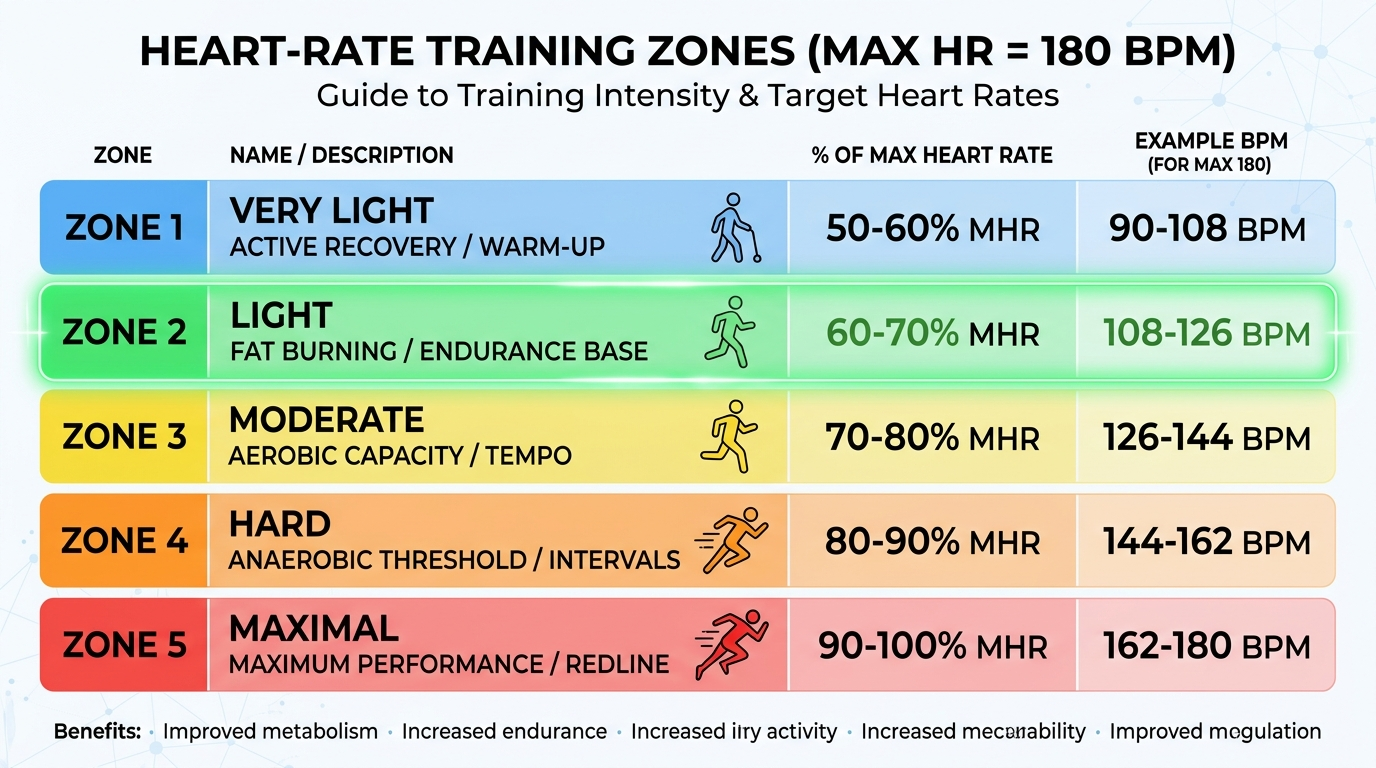
Zone 2 only makes sense inside the full picture. Heart rate training divides effort into five zones, each a percentage of your maximum heart rate. Here's the full map, with example heart rates for a 40-year-old whose estimated maximum is 180 beats per minute.
| Zone | % of max HR | Example BPM | How it feels |
|---|---|---|---|
| Zone 1 | 50 to 60% | 90 to 108 | Very light, a warm-up stroll |
| Zone 2 | 60 to 70% | 108 to 126 | Easy, can hold a conversation |
| Zone 3 | 70 to 80% | 126 to 144 | Moderate, talking gets harder |
| Zone 4 | 80 to 90% | 144 to 162 | Hard, only short phrases |
| Zone 5 | 90 to 100% | 162 to 180 | Maximal, cannot talk |
Notice how narrow zone 2 is: a band of roughly 18 beats per minute for this example. Drift up into zone 3, which feels barely harder, and you lose the specific benefits. Get your own personalized bands with the heart rate zones calculator rather than guessing from how you feel.
How to Find Your Zone 2
There are three ways to find your zone 2, from quickest to most accurate. Start with the math, then confirm with your body.
The fastest is the formula. Estimate your maximum heart rate, then take 60 to 70% of it. The classic estimate is 220 minus your age, though the slightly more accurate 208 minus 0.7 times your age is worth using. For a 40-year-old, that's roughly a 180 maximum and a zone 2 band of about 108 to 126 beats per minute. It's an estimate, not gospel, because individual maximums vary, but it gets you close enough to start.
The second method is the talk test, and it's surprisingly reliable. If you can speak in complete sentences but couldn't comfortably sing, you're likely in zone 2. The moment talking becomes choppy, you've drifted too high. The third and most precise approach combines a chest-strap heart rate monitor with the formula, so you can see in real time when you stray out of the zone. Most people who try this are shocked to learn their "easy" pace was actually zone 3 all along.
What Zone 2 Does for Your Body
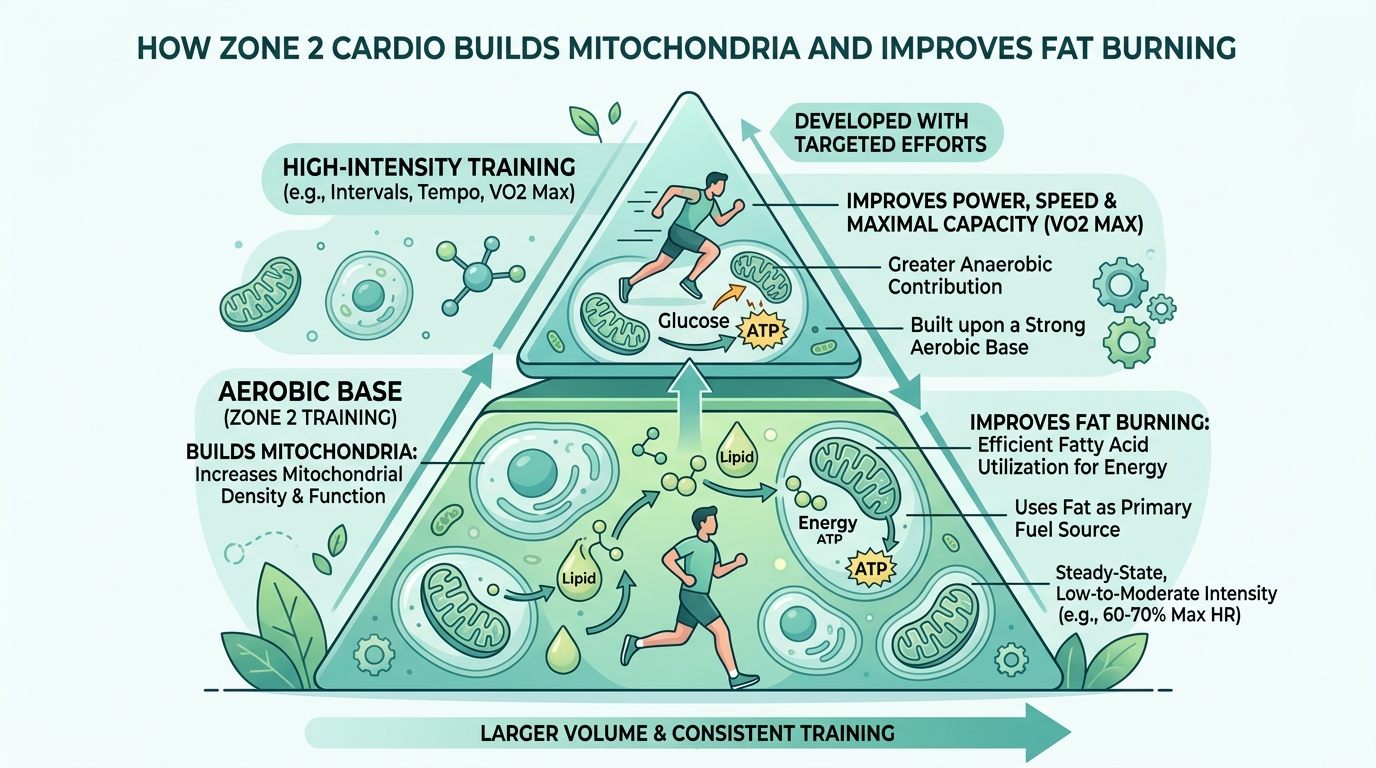
The payoff for staying in this unglamorous zone is real and specific. Zone 2 training is the most effective intensity for building mitochondria, the tiny power plants in your cells that turn fat and oxygen into energy. More mitochondria means a bigger aerobic engine, which improves everything from your endurance to your day-to-day energy.
It also trains your body to burn fat efficiently at higher and higher efforts, raising the intensity at which you can work before fatigue sets in. And because it's low-stress, you can do a lot of it without the recovery cost or injury risk of constant hard training. Pair that aerobic base with the occasional harder session and your overall fitness, including markers like your VO2 max, improves more than it would from hammering yourself every workout. Zone 2 is the foundation everything else is built on.
How to Train Zone 2 Without Wrecking It
The most common mistake is going too hard. Zone 2 should feel almost frustratingly easy, and ego makes people creep up into zone 3, where they get neither the recovery of true easy training nor the benefit of true hard training, the dreaded "gray zone." If you finish a zone 2 session feeling tired, you probably weren't in zone 2.
A practical structure is 30 to 60 minutes of continuous zone 2 effort, two to four times a week, on whatever cardio you enjoy: walking on an incline, easy jogging, cycling, or rowing. Hills and even brisk walking count, especially when you're starting out, since beginners hit zone 2 at gentler efforts. The discipline is in holding back. Estimate how many calories a session burns with the calorie burn calculator if you're also managing weight, but resist the urge to chase the bigger number by going harder.
Build Your Zones
Zone 2 cardio is one of the rare fitness trends that delivers what it promises, but only if you train in the actual zone rather than your imagined version of it. Calculate your maximum heart rate, take 60 to 70% of it, confirm with the talk test, and keep most of your cardio there.
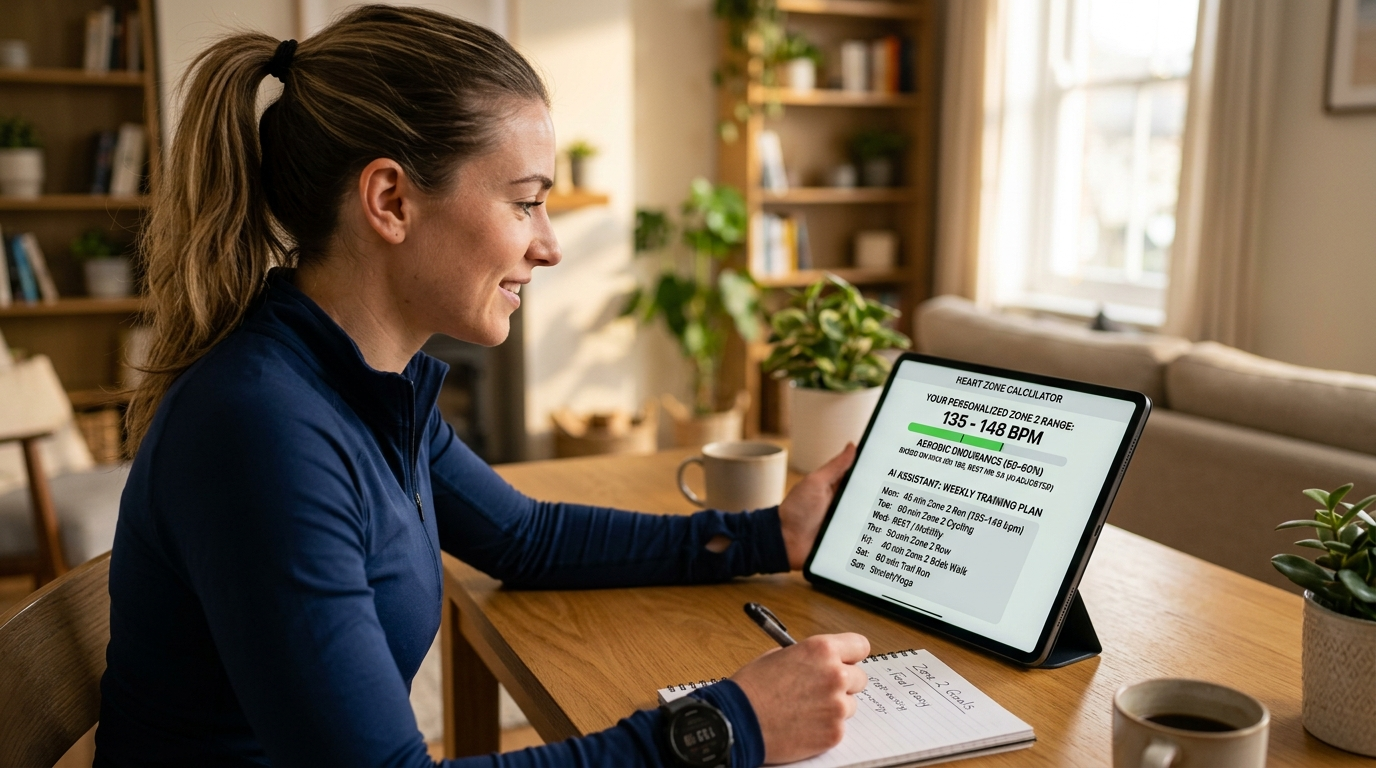
This is a natural question for the built-in AI assistant on the calculator pages. Tell it something like "I'm 40, what's my zone 2 heart rate and how should I structure my week," and it turns your numbers into a plan instead of leaving you with a raw range. Pair your zones with your maintenance calories from the TDEE calculator if fat loss is part of the goal. The trend will fade, as trends do. The aerobic base you build training easy will not.
Frequently Asked Questions
What is zone 2 cardio?
Zone 2 cardio is exercise performed at roughly 60 to 70% of your maximum heart rate, an easy, conversational pace you could sustain for a long time. At this intensity your body burns mostly fat for fuel and builds aerobic fitness with minimal fatigue, which is why endurance athletes spend most of their training there.
How do I calculate my zone 2 heart rate?
First estimate your maximum heart rate using 220 minus your age, or the more accurate 208 minus 0.7 times your age. Then take 60 to 70% of that number. For a 40-year-old with a maximum of about 180, zone 2 is roughly 108 to 126 beats per minute.
How can I tell if I am in zone 2 without a heart rate monitor?
Use the talk test. In zone 2 you can hold a conversation in full sentences but would struggle to sing. If you can only speak in short phrases, you have drifted into zone 3 or higher and should ease off the pace.
What are the benefits of zone 2 cardio?
Zone 2 builds mitochondria, improves how efficiently your body burns fat, raises your aerobic base, and carries a low injury and recovery cost. Together these improve endurance and fitness markers like VO2 max while letting you train frequently without burning out.
How often should I do zone 2 cardio?
A common approach is 30 to 60 minutes of zone 2, two to four times per week, on any cardio you enjoy such as walking, jogging, cycling, or rowing. The key is keeping the effort genuinely easy rather than letting it creep into a harder zone.
Is walking zone 2 cardio?
It can be, especially for beginners or when walking on an incline. Zone 2 is defined by heart rate, not the activity, so brisk walking that keeps you at 60 to 70% of your maximum heart rate counts as zone 2 training.
Why is zone 2 cardio so popular right now?
Longevity researchers and endurance coaches popularized the finding that elite athletes do roughly 80% of their training at easy zone 2 intensity. That, combined with its low injury risk and accessibility, made it an appealing, science-backed alternative to constant high-intensity workouts.