
Calorie Deficit vs Calorie Cycling: Which Weight Loss Method Works Better?
Both methods produce the same weekly calorie gap — so why do so many people find one dramatically easier to stick to? The science and the math, side by side.
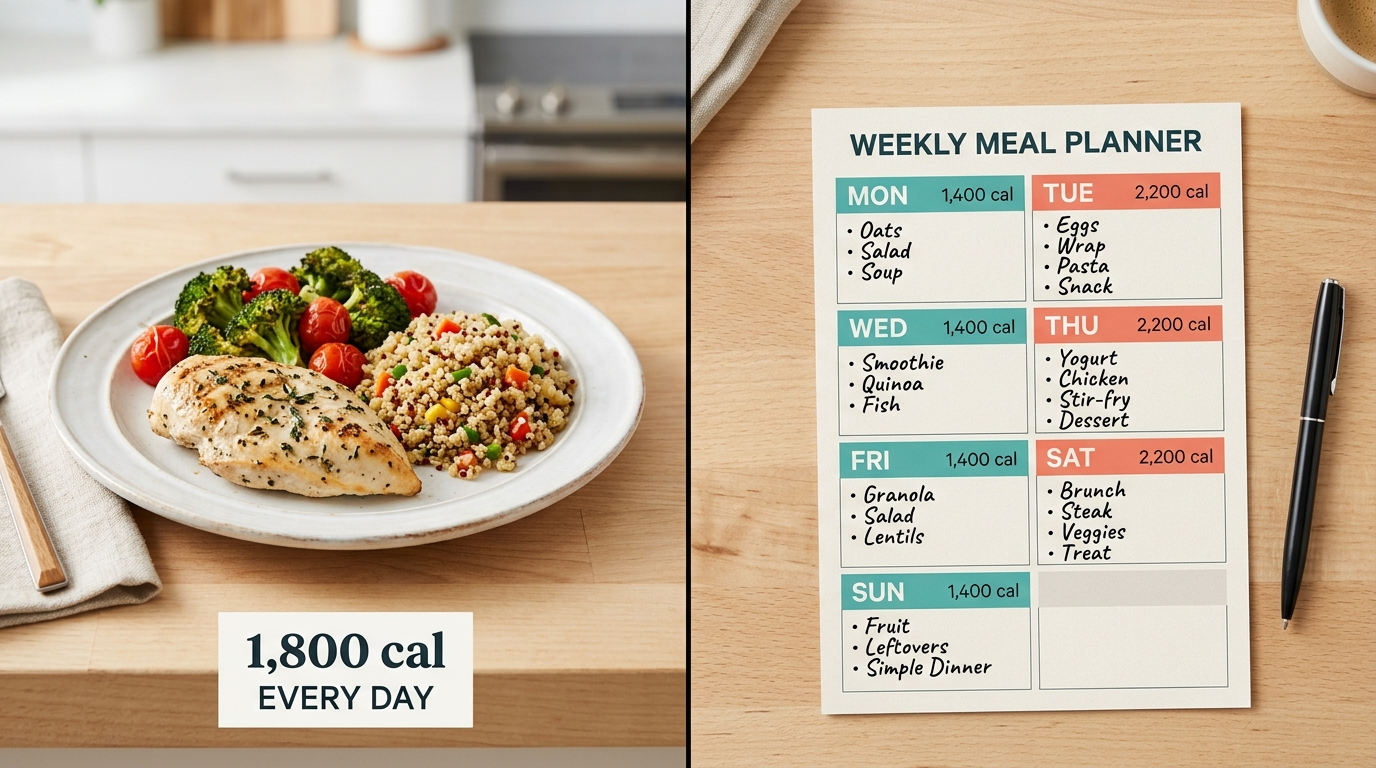
Calorie deficit and calorie cycling produce the exact same weekly energy gap. Identical math, identical fat loss on paper. So why do so many people quit one in three weeks and stick with the other for months? The difference isn't in the calories. It's in your head, your weekends, and the way restriction wears people down. This is the honest side-by-side of two methods that look the same on a spreadsheet and feel completely different in real life.
A flat calorie deficit means eating the same reduced amount every day. Calorie cycling means hitting a lower number on some days and a higher number on others, while keeping the weekly total the same. Same destination, two routes. Let's put a real week of each next to the other and see where they actually diverge.
Same Math, Different Schedule
Start with the principle that governs both: weekly energy balance drives fat loss, not daily balance. Your body does not reset at midnight. It responds to the running total across days. That single fact is why two very different eating patterns can produce the same result.
If the weekly calories match, the fat loss matches. A flat deficit and a cycled plan that sum to the same weekly number are, to your fat cells, the same diet. The only thing that changes is how the calories are distributed, and distribution is where human behavior enters the picture.
A Week of Each, Side by Side
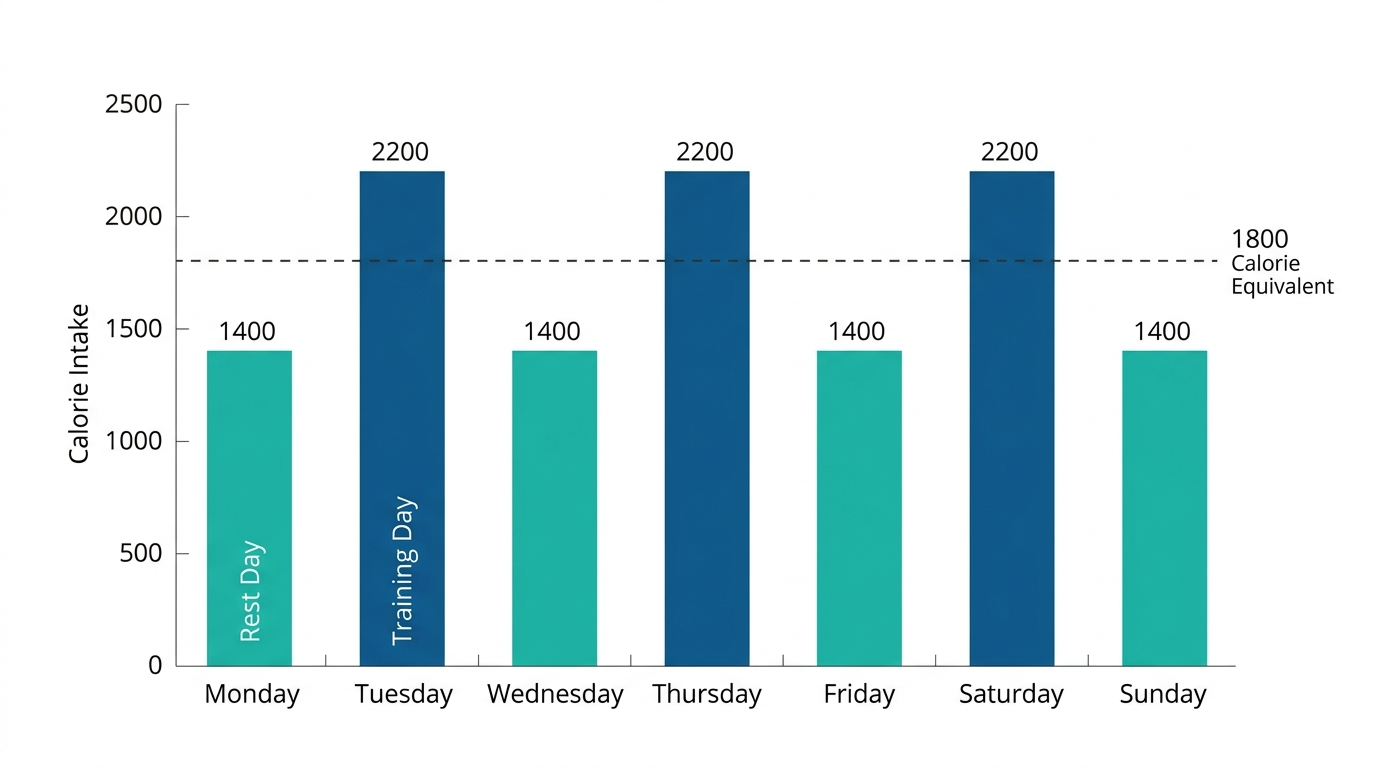
Here are two plans that both total 11,200 calories for the week. One holds flat at 1,600 every day. The other dips to 1,400 on weekdays and lifts to 2,100 on the weekend. Watch the weekly total stay identical.
| Day | Flat deficit | Calorie cycling |
|---|---|---|
| Monday | 1,600 | 1,400 |
| Tuesday | 1,600 | 1,400 |
| Wednesday | 1,600 | 1,400 |
| Thursday | 1,600 | 1,400 |
| Friday | 1,600 | 1,400 |
| Saturday | 1,600 | 2,100 |
| Sunday | 1,600 | 2,100 |
| Weekly total | 11,200 | 11,200 |
Same fat loss either way. The cycled plan simply borrows 200 calories from each weekday to fund a more generous weekend. Build either version off your maintenance line using the TDEE calculator, then set the daily targets with the calorie calculator.
Why the Scale Doesn't Care, But Your Brain Does
Since the weekly total decides the result, the choice between them is really a choice about adherence. The best diet is the one you actually follow, and the two patterns suit different personalities and different lives.
Flat deficits reward people who like routine and find decisions tiring. Same number every day, no math, no temptation to "save up." Cycling rewards people whose social lives cluster on weekends, who'd rather eat lighter Monday through Friday to enjoy a dinner out on Saturday without guilt. Neither is morally better. One of them is simply easier for you to keep doing past week three, and that's the one that wins.
Does Cycling Actually Beat Metabolic Adaptation?
A common claim is that cycling "tricks" your metabolism and prevents the slowdown that comes with dieting. The evidence is softer than the marketing. Higher-calorie days may modestly support hormones tied to appetite and energy, but the research does not show a large or reliable metabolic advantage over a flat deficit with the same weekly total.
The real benefit of cycling is psychological, not metabolic. Planned higher days reduce the feeling of constant deprivation, which keeps people in the deficit longer. That longer adherence, not a metabolic trick, is what produces better results for the people it suits. Honesty about the mechanism helps you pick for the right reason.

What Actually Drives Fat Loss, and What Doesn't
Before choosing between the two patterns, it's worth clearing away the noise about what makes fat loss happen at all. A huge amount of diet advice fixates on things that barely matter while ignoring the one thing that does.
The thing that matters is the energy balance over time: eating less than you burn across the week. That's it. The things that get far more attention than they deserve include meal timing, eating after 6pm, how many meals you eat per day, and so-called "fat-burning" foods. None of these meaningfully change fat loss if the weekly calorie total is the same. Six small meals and two big ones produce identical results when the totals match. Eating your last meal at 9pm doesn't store more fat than eating it at 6pm.
This is exactly why the deficit-versus-cycling question is really a question about adherence rather than mechanism. Both methods control the one variable that counts, the weekly total, so neither has a metabolic edge. Once you understand that calories across the week are the engine and everything else is decoration, you stop chasing tricks and start choosing the structure you can actually stick to. That shift in focus is worth more than any specific eating pattern.
Who Each Method Actually Suits
Since the results are identical when the weekly total matches, the right choice comes down to who you are and how your life is structured. Neither method is advanced or beginner; they simply fit different people.
A flat deficit suits people who find comfort in routine and get tired of making decisions. Eating the same amount every day removes a daily negotiation, and there's no temptation to "bank" calories for later. It also suits anyone who knows that a single high-calorie day tends to spiral, because there are no high days to trigger the slide. If you've ever told yourself "I'll just have a little" and lost the afternoon, the flat approach protects you from yourself.
Calorie cycling suits people whose social and emotional eating clusters predictably, usually on weekends. If Friday dinners out and Sunday family meals are non-negotiable parts of your life, building the week around them, eating lighter on weekdays to fund them, turns a source of guilt into a planned feature. It also suits people who train hard on specific days and want more fuel on those days. The pattern works because it bends to your real life instead of fighting it.
How to Set Up Calorie Cycling Correctly
If cycling fits you, setting it up is straightforward. The one rule you cannot break is that the weekly total has to match the deficit you'd run on a flat plan. Everything else is just distribution.
- Find your weekly target first. Take your daily deficit and multiply by seven. That total is your budget for the week, and it doesn't change.
- Choose your high days. Usually two, placed where your life calls for them, often the weekend.
- Pull calories from the low days to fund the high ones. Drop weekdays modestly so the higher weekend days still leave the weekly total intact.
- Keep the swing reasonable. A few hundred calories between high and low days is plenty. Wild swings make the low days miserable and the high days easy to overshoot.
A common beginner error is treating high days as "anything goes." They aren't free days; they're planned higher-calorie days with a number attached. The moment a high day becomes an untracked free-for-all, the weekly total blows out and the whole equivalence breaks. Cycling only matches a flat deficit if the high days stay inside the plan.
The Rules That Matter More Than the Pattern
Whichever method you pick, a few things matter far more than the deficit pattern itself. Get these right and either approach works; get them wrong and neither will.
Protein comes first. Keeping protein high, around 0.7 to 1.0 grams per pound of body weight, protects muscle during a deficit and keeps you fuller, which makes either method easier to sustain. Tracking accuracy comes second. Most people underestimate what they eat by a wide margin, so the deficit they think they're running is often smaller than reality. Whether you eat flat or cycled, the weekly total only works if you're measuring it honestly. Set both up from your maintenance line with the calorie calculator, and let protein and accurate tracking do the heavy lifting.
Which One Should You Pick?
Match the method to your temperament, not to a headline. Choose a flat deficit if you value simplicity, dislike tracking, or tend to lose control once a "high day" starts. Choose cycling if structured weekends keep you sane and you can hold the weekday discipline that funds them.
This is a question the built-in AI assistant on the calculator pages is well suited to. After you set your numbers, you can describe your week honestly, something like "I do well on weekdays but always overeat at weekend dinners," and it will suggest which structure fits and how to spread the calories. Pair that with a protein floor from the macro calculator so muscle is protected either way. The winning method is whichever one still has you on plan in month three.
Frequently Asked Questions
What is a calorie deficit?
A calorie deficit means consuming fewer calories than your Total Daily Energy Expenditure (TDEE). A 500-calorie daily deficit creates a 3,500-calorie weekly deficit, producing approximately one pound of fat loss per week under typical conditions.
What is calorie cycling?
Calorie cycling alternates between higher-calorie and lower-calorie days while maintaining the same total weekly deficit. For example, eating 1,400 calories on five weekdays and 2,000 calories on two weekend days rather than a flat 1,600 every day.
Which produces more weight loss — calorie deficit or calorie cycling?
Both produce identical results when the weekly total calories are equal. The primary advantage of calorie cycling is psychological adherence — many people sustain it longer because planned high-calorie days reduce feelings of deprivation.
Does calorie cycling prevent metabolic adaptation?
Research suggests calorie cycling may partially reduce the metabolic slowdown that occurs during prolonged calorie restriction, though evidence is not conclusive. The main benefit remains improved adherence over time rather than a purely metabolic advantage.
How do I know what my calorie deficit should be?
Calculate your TDEE first using your weight, height, age, and activity level. Then subtract 300–500 calories for a moderate deficit (0.5–1 lb loss per week) or 500–750 calories for a more aggressive deficit. Never go below your BMR for extended periods.