
Lose Weight Fast or Lose Weight Slow: What the Science Actually Says
Aggressive calorie restriction produces faster scale results but causes up to 25% of weight lost to come from muscle. Slower deficits preserve lean mass, reduce hunger hormones, and produce better long-term outcomes. Here's the full breakdown.
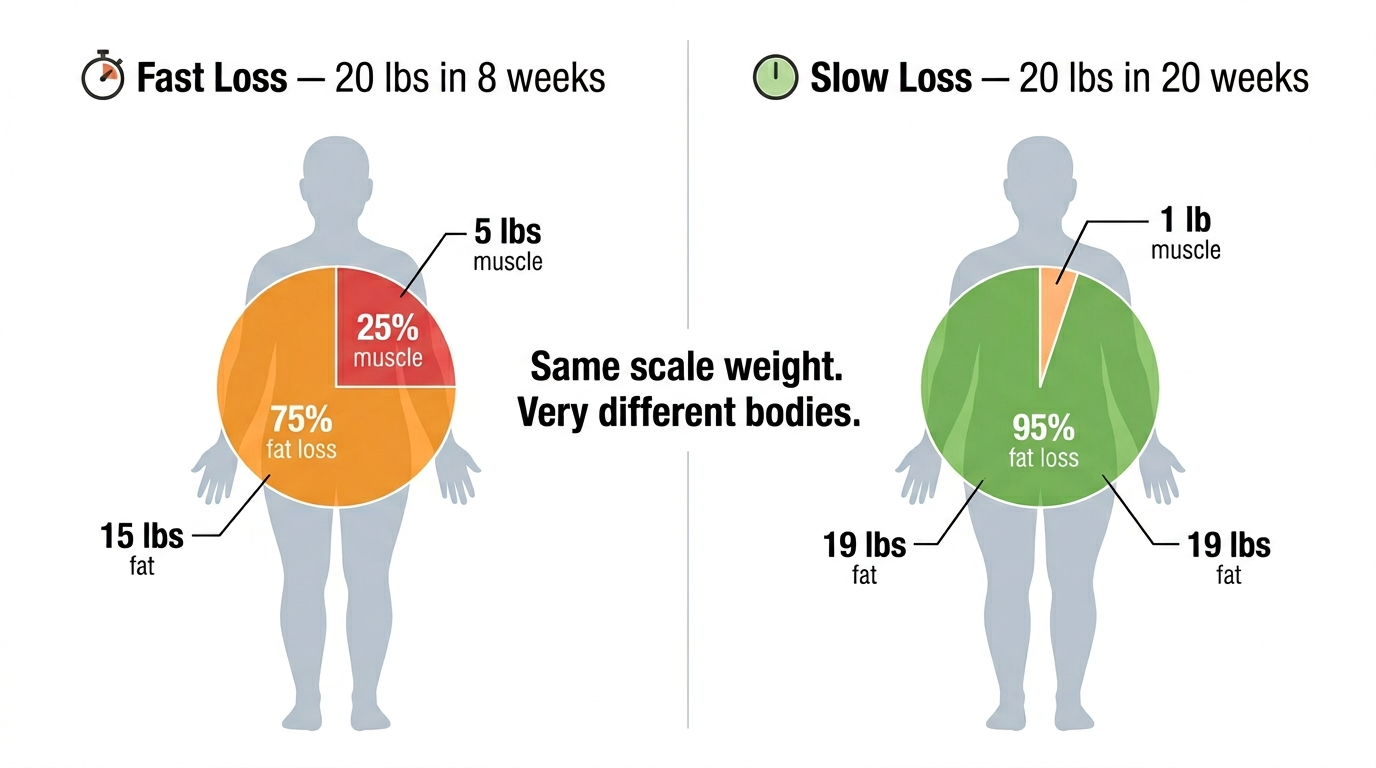
Two people both lose 20 pounds. One does it in 8 weeks on a crash diet. The other takes 20 weeks. Step on a scale and they look like equal successes. Look underneath the number and they are nothing alike: the fast loser gave up a quarter of that weight in muscle, while the slow loser kept almost all of it. A year later, one has kept the weight off and the other has not. The speed of weight loss decides what you actually lose, and that's the part the scale will never show you.
Faster is not simply a more impatient version of slower. Pushing the deficit harder changes the biology of what comes off your body and how your metabolism responds. Before you pick a pace, it helps to see exactly what each one costs.
The Scale Is the Wrong Scoreboard
The number on the scale measures total weight, and total weight is a blend of fat, muscle, water, and glycogen. A fast drop looks impressive partly because a chunk of it is water and muscle, neither of which you wanted to lose. The goal was never to weigh less. It was to carry less fat while keeping the muscle that keeps you strong and keeps your metabolism running.
Judging a diet by scale speed rewards exactly the wrong outcome. The faster the weight comes off, the larger the share that comes from muscle. A better scoreboard tracks body composition, which is why a body fat reading tells you far more than the scale alone. The body fat percentage calculator shows whether the weight leaving is the weight you wanted gone.
What You Actually Lose: Fat vs Muscle
Here's the same 20 pounds lost two ways. The figures reflect what research on aggressive versus moderate deficits consistently shows about the fat-to-muscle split.
| Outcome | Fast (8 weeks) | Slow (20 weeks) |
|---|---|---|
| Fat lost | ~15 lb | ~19 lb |
| Muscle lost | ~5 lb (25%) | ~1 lb (5%) |
| Weekly rate | 2.5 lb | 1 lb |
| Metabolism after | Markedly suppressed | Largely preserved |
Same 20 pounds on the scale. Four pounds of difference in muscle, which is the difference between looking leaner and looking smaller-but-soft, and the difference in how many calories your body burns afterward.
Metabolic Adaptation: The Hidden Tax on Fast Loss
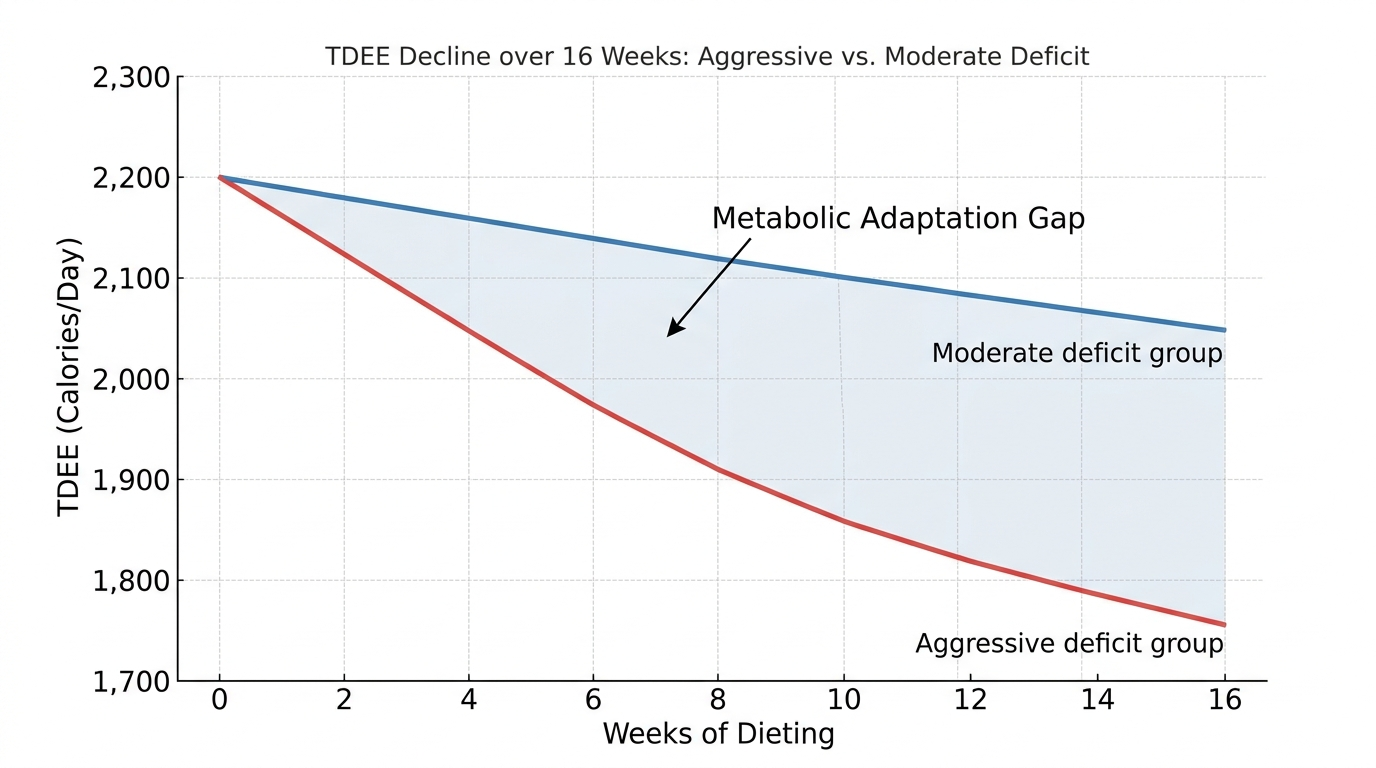
When you cut calories hard, your body fights back by burning fewer. Some of this is simple: a lighter body needs less fuel. But a large slice comes from adaptation, where your body becomes more efficient and quietly reduces the small unconscious movements that burn calories all day, known as NEAT.
Research suggests NEAT can fall by 200 to 400 calories a day during aggressive restriction. That's a meaningful chunk of your planned deficit vanishing without you noticing, which is why fast diets so often stall. The harder you push, the harder your body pushes back, and the suppression can linger long after the diet ends. You can see your maintenance line shrinking by recalculating on the TDEE calculator as your weight drops.
Why Fast Losers Regain More
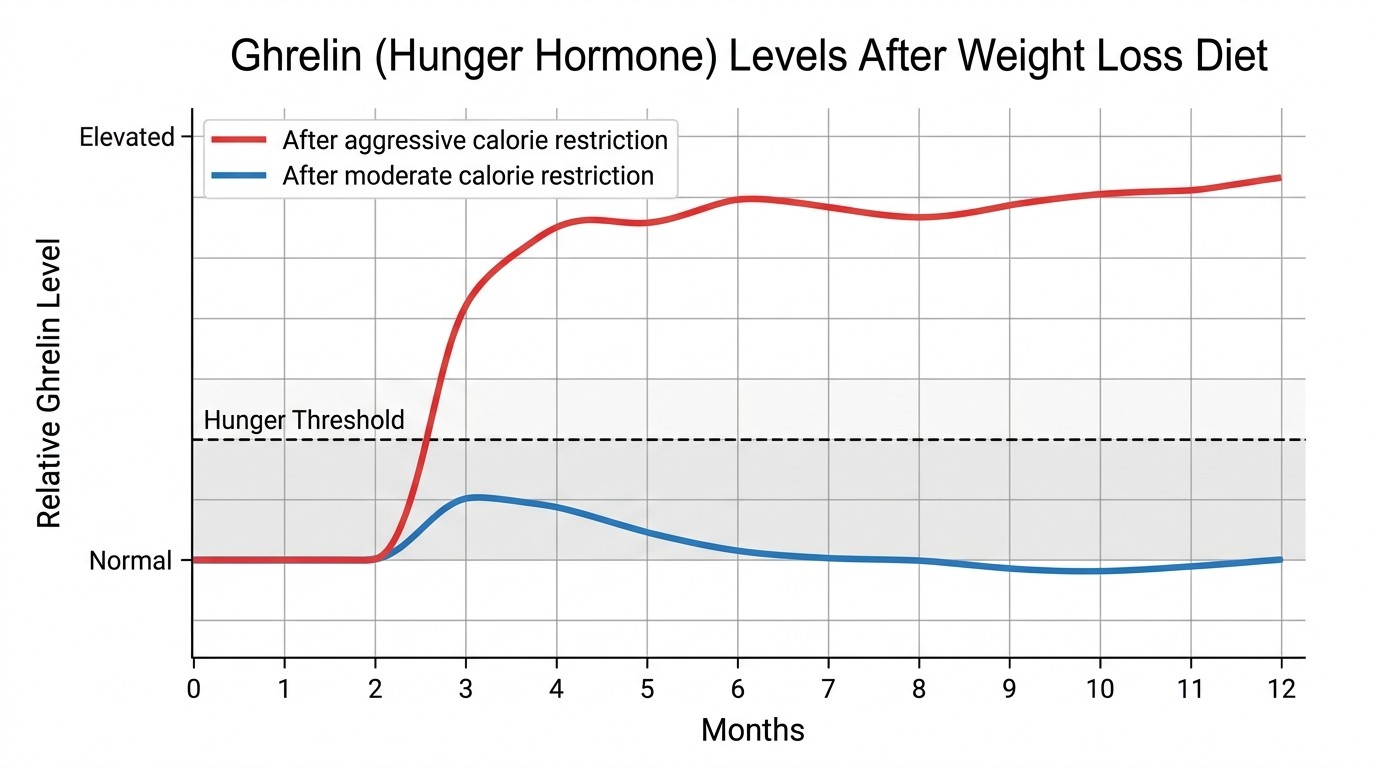
The cruelest part comes after the diet. Studies following people after rapid weight loss consistently find higher regain rates than after moderate loss. Two forces drive it: the suppressed metabolism burns fewer calories than expected, and appetite hormones are pushed up, so you're hungrier on top of needing less food.
Fast loss often wins the eight-week sprint and loses the two-year race. Slow loss produces smaller hormonal and metabolic disruptions, which makes the new weight physiologically easier to keep. Since maintenance is the real goal, the slower path usually delivers the result people actually wanted in the first place.
How to Tell If You're Losing Fat or Muscle
Since the scale can't distinguish fat from muscle, you need other signals to know whether your weight loss is the good kind. Watching the right indicators tells you early whether to hold your course or ease off the pace.
- Strength in the gym: the clearest sign. If your lifts hold steady or climb while you lose weight, you're keeping muscle. If your strength drops fast, you're losing it.
- Tape measurements: a shrinking waist while your strength holds means fat is leaving and muscle is staying. Measure the same spots every two weeks.
- Energy and mood: moderate fat loss leaves you functional. Crashing energy, constant cold, poor sleep, and irritability are warning signs of too aggressive a deficit.
- Progress photos: taken in the same light and pose, they often show recomposition the scale completely hides.
If the warning signs pile up, faster is not working, no matter what the scale says. Strength falling off a cliff, energy in the floor, and a stalled tape measure all point to muscle loss and metabolic slowdown. The right response is to shrink the deficit, raise protein, and slow down, not to cut calories further. The scale rewards speed; your body rewards patience, and these signals tell you which one you're actually serving.
How to Protect Muscle While Losing Fat
The whole case against fast loss rests on the muscle you give up. So the practical question is how to lose fat while keeping as much muscle as possible, and the answer comes down to three levers you control.
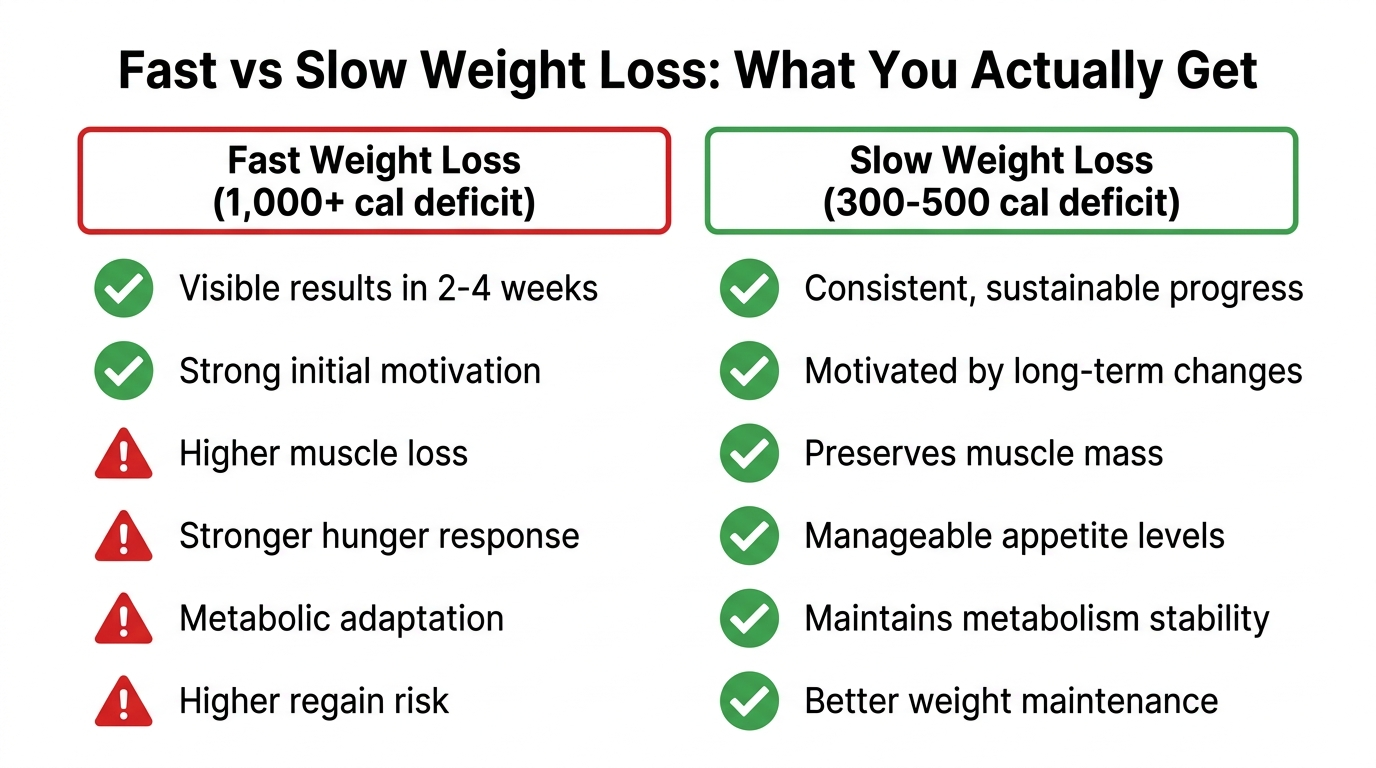
- Keep the deficit moderate. 300 to 500 calories below maintenance signals your body to burn fat for fuel. A deficit twice that size forces it to break down muscle for energy too.
- Eat enough protein. Around 0.7 to 1.0 grams per pound of body weight gives your body the raw material to hold onto muscle during a deficit. The protein intake calculator sets your target.
- Lift weights. Two to three resistance sessions a week tell your body the muscle is still needed. Use it and you keep it; sit still in a deficit and you lose it.
These three together are far more powerful than any clever dieting trick. Studies on moderate deficits paired with adequate protein and resistance training show muscle loss falling to roughly 10% or less of total weight lost, compared with 20 to 30% on aggressive deficits with no training. The slow path doesn't just lose less muscle by accident; it actively defends it.
What Crash Dieting Does to Your Hunger Hormones
Fast weight loss doesn't only cost muscle. It changes the hormones that control hunger, and not in your favor. As you lose weight quickly, leptin, the hormone that signals fullness, drops sharply. At the same time ghrelin, the hormone that drives hunger, climbs. The result is a body that feels hungrier and less satisfied by food, exactly when you're trying to eat less.
The cruel part is that these hormonal shifts are larger and more persistent after aggressive dieting, and they can linger for months after you stop. This is a major reason crash diets end in rebound: you're not weak, you're fighting a hormonal environment your own rapid weight loss created. Slower loss produces gentler hormonal changes, which is a big part of why moderate dieters keep the weight off more easily. You're working with your physiology instead of provoking it.
When Faster Loss Is Actually the Right Call
None of this means slow is always right for everyone. There are situations where a faster initial pace is reasonable, and it's worth being honest about them rather than pretending one speed fits all.
People starting from a higher body weight can often lose faster early on with a smaller share coming from muscle, simply because they have more fat to draw on. Some medically supervised programs use rapid loss deliberately for health reasons, with monitoring and high protein to protect lean mass. And for a few people, fast early results provide the motivation that carries them into long-term habits. The key distinction is that these faster approaches still protect muscle through protein and training, and ideally happen with guidance. Fast and careless is the problem. Fast, protein-rich, and supervised is a different thing entirely.
The Rate That Actually Works
The sustainable target is losing 0.5 to 1% of your body weight per week. At 180 pounds, that's roughly 0.9 to 1.8 pounds a week. Pair that moderate deficit with protein around 0.7 to 1.0 grams per pound and two to three resistance sessions a week, and you protect almost all your muscle while the fat comes off.
Set the deficit precisely with the calorie calculator, then use the built-in AI assistant on the page to sanity-check your pace. Tell it your weight and timeline, something like "I want to lose 20 pounds, how fast is safe," and it translates that into a weekly rate and a deficit that won't cost you muscle, instead of leaving you to guess and overshoot. Slower feels less dramatic week to week. It's the version that's still gone a year from now.
Frequently Asked Questions
How fast is it safe to lose weight?
Most nutrition researchers recommend losing no more than 0.5 to 1% of your body weight per week. At 180 pounds, that is 0.9 to 1.8 pounds per week. Rates faster than this increase the proportion of weight lost from lean muscle mass rather than fat and trigger more severe metabolic adaptation, making the weight harder to keep off after the diet ends.
Does losing weight too fast cause muscle loss?
Yes. Research shows that deficits above 1,000 calories per day cause 20 to 30% of weight lost to come from lean muscle mass rather than fat. Moderate deficits of 300 to 500 calories per day, combined with adequate protein intake and resistance training, can reduce muscle loss to roughly 10% or less of total weight lost.
What is metabolic adaptation and why does it slow weight loss?
Metabolic adaptation is the process by which your body reduces its calorie expenditure in response to sustained calorie restriction. Your TDEE drops beyond what weight loss alone would predict, because your body becomes more efficient and unconsciously reduces small movements (NEAT). Research suggests NEAT can decline by 200 to 400 calories per day during aggressive restriction, significantly eroding your planned calorie deficit.
Is it better to lose weight quickly and then maintain, or lose slowly over a longer period?
Long-term outcomes strongly favor slower weight loss. Studies following people after rapid weight loss programs consistently find higher regain rates than after moderate programs, partly because aggressive restriction causes larger suppression of hunger hormones and metabolic rate that can persist for over a year after the diet ends. Slower loss produces smaller hormonal and metabolic disruptions, making maintenance physiologically easier.
What calorie deficit is best for losing weight without losing muscle?
A deficit of 300 to 500 calories below your TDEE is the standard recommendation for preserving lean mass during fat loss. Pair this with protein intake of 0.7 to 1.0 grams per pound of body weight and 2 to 3 resistance training sessions per week. These two factors significantly offset muscle loss even at moderate deficits and are more effective than trying to maintain muscle through aggressive deficit management alone.