
How to Figure Out Your TDEE and Use It to Stop Guessing About Calories
Your Total Daily Energy Expenditure is the one number that makes every calorie decision accurate. Here's how to calculate it using the Mifflin-St Jeor formula, choose the right activity multiplier, and adjust when the results don't match.

Almost everyone who counts calories is anchoring to the wrong number. They pick a round figure like 1,500 or 2,000 from a magazine, a friend, or a guess, then wonder why the scale won't move. Your TDEE, your Total Daily Energy Expenditure, is the number that ends the guessing, because it's the exact amount of energy your body burns in a day. Get it right and every calorie decision becomes arithmetic instead of hope. Here's how to find yours and, more importantly, how to fix it when the formula is slightly off.
TDEE has two parts: the calories you'd burn lying in bed all day, and the calories you burn moving. Nail both and you have your true maintenance line. Eat at it and your weight holds. Eat below it to lose, above it to gain. The whole game runs off this one figure, so it's worth getting right rather than guessing.
The Number That Ends the Guesswork
A calorie target with no TDEE behind it is a shot in the dark. You might be eating 200 below maintenance, or 200 above, and you'd have no way to tell until weeks of no progress make it obvious. TDEE turns that blind guess into a starting point you can measure against.
TDEE is not a fixed lifetime number. It shifts as your weight, activity, and age change, which is why a figure that worked two years ago may be quietly wrong today. Build it in two steps, then calibrate it against what the scale actually does.
Step 1: Find Your BMR
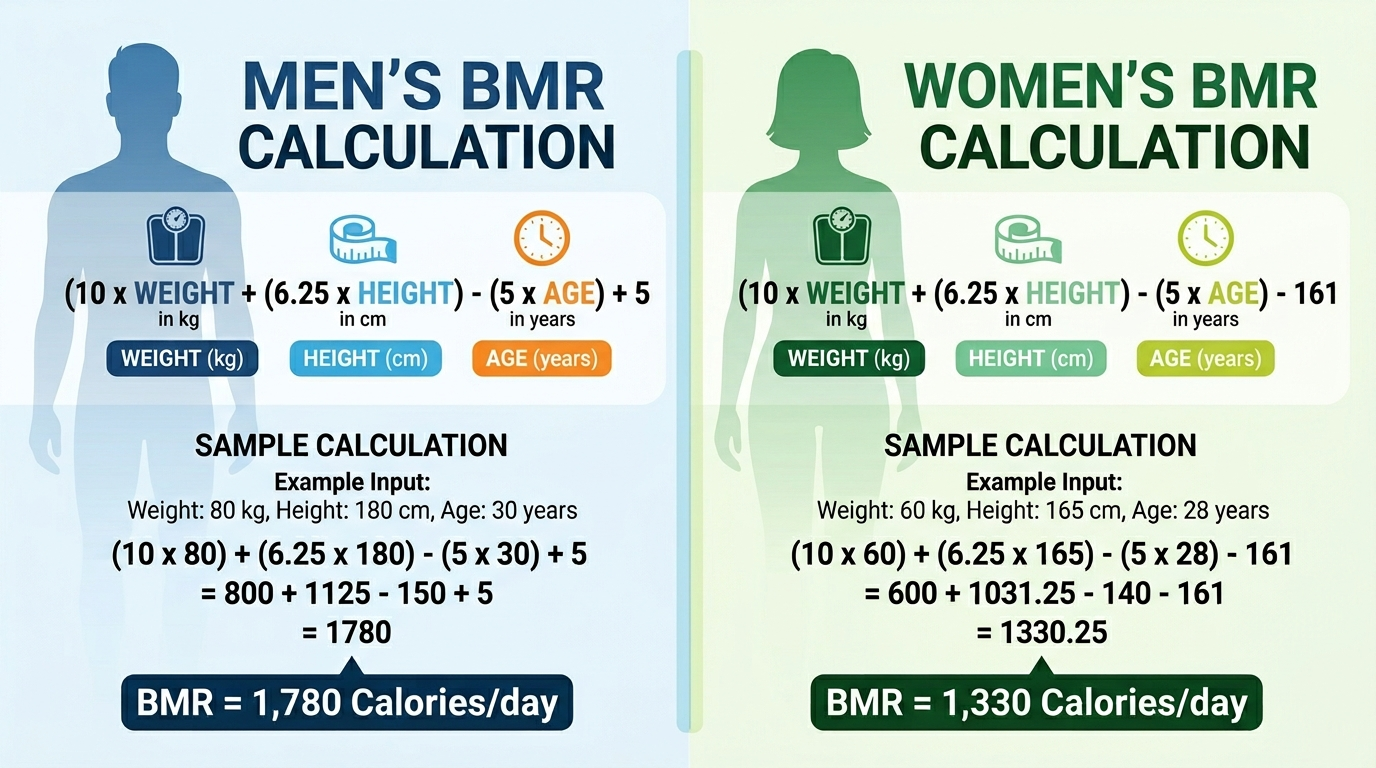
Your Basal Metabolic Rate is what your body burns at complete rest. The Mifflin-St Jeor equation is the most accurate widely used formula. For women it's (10 × weight in kg) + (6.25 × height in cm) − (5 × age) − 161. For men, the same but +5 instead of −161.
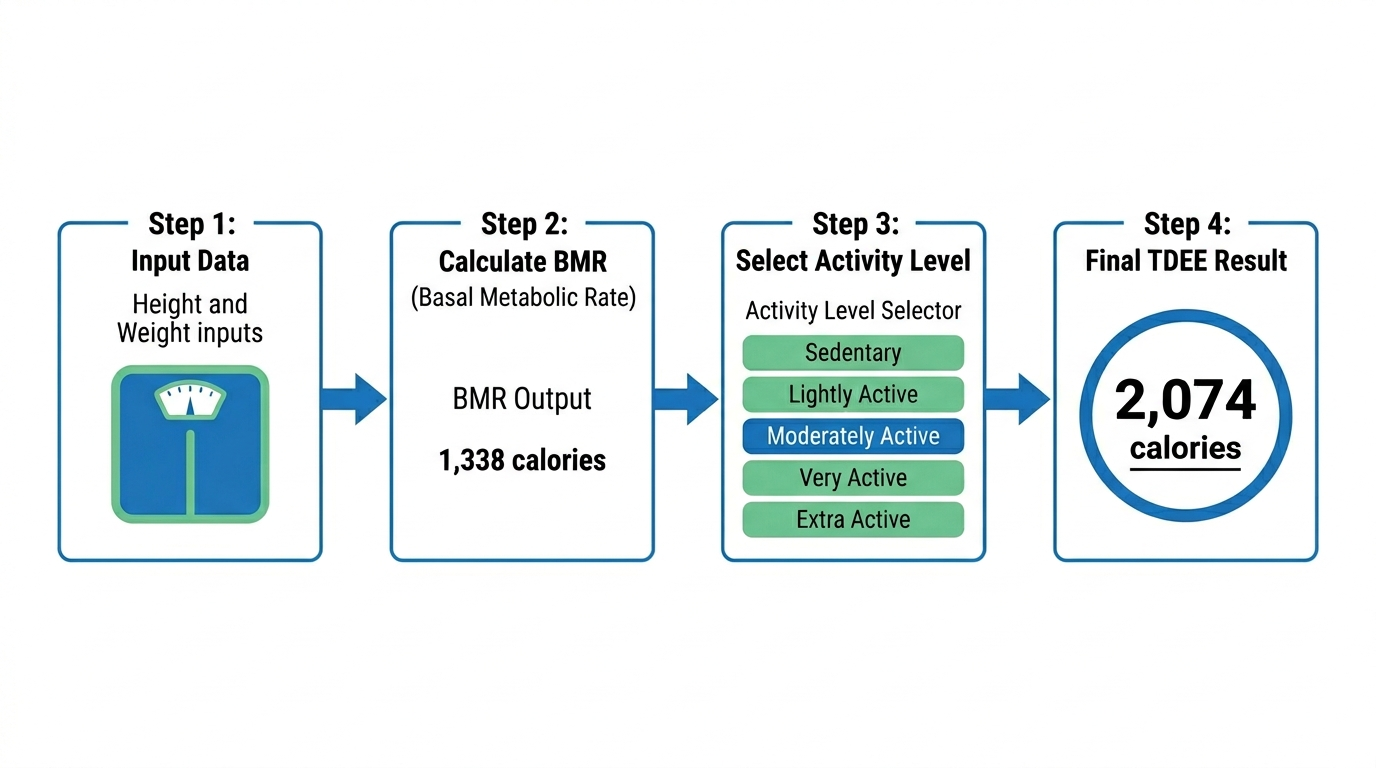
Work an example. A 35-year-old woman, 5'5" and 150 pounds, converts to 68 kg and 165 cm. Her BMR is (10 × 68) + (6.25 × 165) − (5 × 35) − 161, which lands at about 1,375 calories. That's the floor: the energy her organs need before she so much as stands up. The BMR calculator runs this for you in seconds so you don't have to do the conversions by hand.
Step 2: The Activity Multiplier, Where Almost Everyone Overshoots
This is where TDEE estimates go wrong. You multiply your BMR by an activity factor, and most people pick a factor one or two steps too high. A few gym sessions a week is "light," not "very active." Be honest here or the whole number inflates.
| Level | Factor | Who actually fits | TDEE |
|---|---|---|---|
| Sedentary | 1.2 | Desk job, little or no exercise | 1,650 |
| Light | 1.375 | Light exercise 1 to 3 days a week | 1,891 |
| Moderate | 1.55 | Real training 3 to 5 days a week | 2,131 |
| Very active | 1.725 | Hard training 6 to 7 days a week | 2,372 |
| Extra active | 1.9 | Physical job plus daily training | 2,613 |
Look at the spread. The same woman has a maintenance line anywhere from 1,650 to 2,613 depending only on this choice. Pick wrong and you're off by hundreds of calories before you've eaten a thing. The TDEE calculator applies the right factor for you, but the honesty about your real activity level has to come from you.
Step 3: Calibrate Against Reality
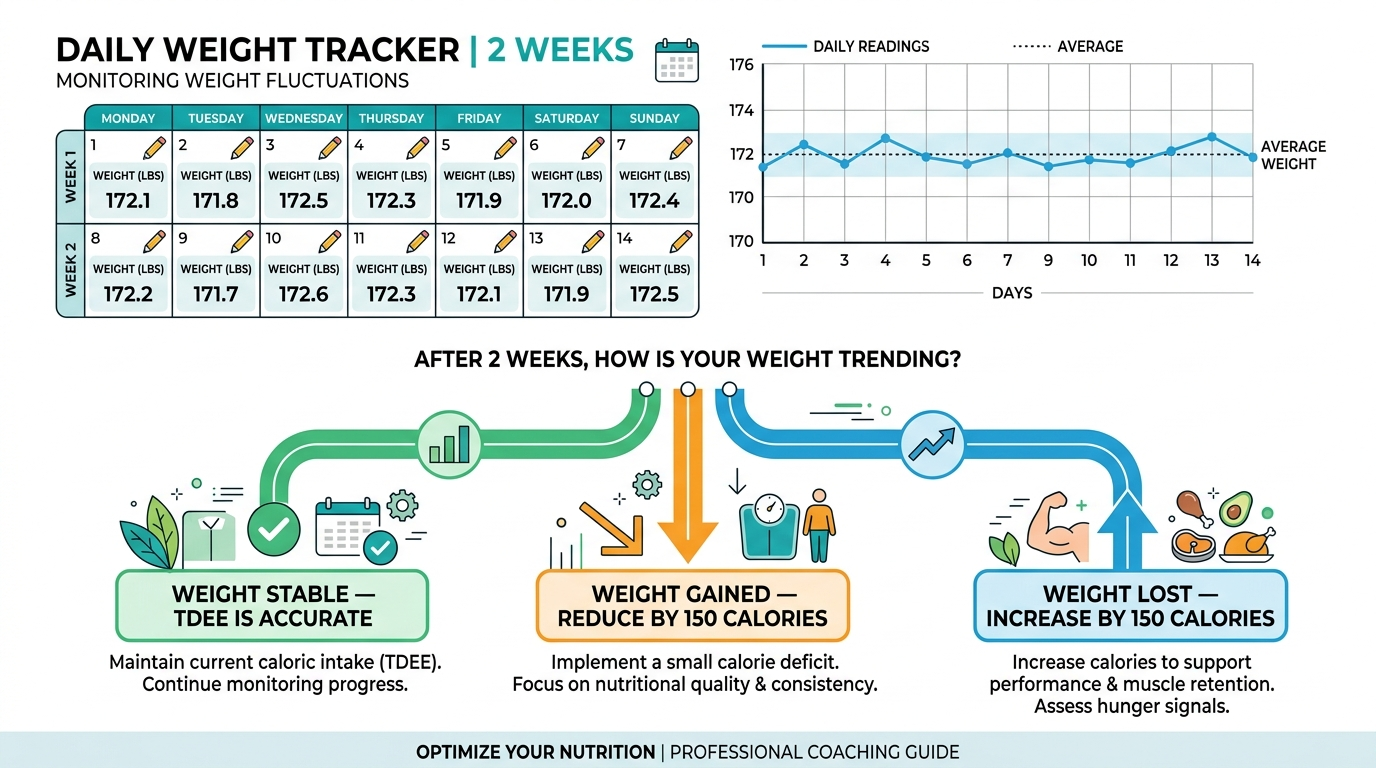
Here's the step the formulas never mention. Mifflin-St Jeor is a population average with a real-world error margin of 10 to 15% for any individual. The calculated number is a starting estimate, not gospel. You confirm it with a two-week test.
Eat at your calculated TDEE for fourteen days and weigh yourself each morning under the same conditions. If your average weight holds steady, your estimate was right. If it creeps up, your real TDEE is a bit lower, so trim 100 to 150 calories. If it drifts down, your real TDEE is higher, so add the same. After one calibration cycle you have a maintenance number tuned to your actual body instead of a textbook average.
The Four Parts of Your Daily Burn
TDEE isn't one thing; it's four things added together. Understanding the parts explains why the activity multiplier is so easy to get wrong and where you actually have control.
- BMR (around 60 to 70%): the energy to keep you alive at rest. The biggest slice, and largely fixed by your size, age, and muscle mass.
- TEF, the thermic effect of food (around 10%): the calories burned digesting what you eat. Protein costs the most to process, which is part of why high-protein diets feel more filling.
- EAT, exercise activity (varies): deliberate workouts. For most people this is smaller than they assume, often 5 to 15% of the total.
- NEAT, everything else you do (varies enormously): walking, fidgeting, standing, chores. This is the wild card that can swing daily burn by hundreds of calories.
The surprise for most people is how small deliberate exercise is and how large NEAT can be. An hour at the gym might burn 300 calories, while a job that keeps you on your feet all day, or simply a habit of walking and moving, can burn far more across the whole day. This is why two people who do the "same workout" can have very different real TDEEs.
Why Two People the Same Size Burn Different Amounts
Take two people with identical height, weight, age, and sex. The formula hands them the same BMR and, if they pick the same activity level, the same TDEE. In reality their true daily burn can differ by several hundred calories, and NEAT is the main reason. One person unconsciously moves all day; the other is mostly still. Neither is exercising more, yet their bodies spend energy at different rates.
Muscle mass adds another layer. More muscle means a higher resting burn, so two people at the same weight but different body compositions won't match. Genetics, sleep, stress, and even temperature nudge the number too. None of this makes the formula useless. It just explains why a calculated TDEE is a smart starting estimate rather than a precise readout, and why the calibration step matters so much.
Common TDEE Mistakes
A handful of predictable errors throw people off, usually in the direction of eating more than they think they're burning.
- Overstating activity: the single most common mistake. Three gym sessions a week is "light," not "very active."
- Eating exercise calories back twice: if your activity multiplier already includes workouts, adding the calories from a fitness tracker double-counts them.
- Never recalculating after weight loss: a lighter body burns less. A TDEE from 30 pounds ago is no longer your TDEE.
- Treating the number as exact: it's an estimate with a 10 to 15% margin. The calibration test, not the calculator, gives you the real figure.
How Your TDEE Changes as You Lose Weight
Here's the trap that catches almost everyone who diets for more than a couple of months: your TDEE is not a fixed number that you calculate once and use forever. It falls as you lose weight, and if you don't adjust, your once-effective deficit quietly shrinks to nothing.
There are two reasons it drops. The first is simple physics: a lighter body requires less energy to move and maintain, so your BMR and the calories you burn in activity both fall as the pounds come off. The second is adaptive thermogenesis, the extra slowdown your body adds on top of that during sustained restriction, partly by quietly reducing your NEAT. Together they mean the 500-calorie deficit you started with might be a 200-calorie deficit three months later, even though you're eating exactly the same amount.
This is the real reason so many people stall. They blame willpower when the actual culprit is an outdated number. The fix is to recalculate your TDEE every time your weight drops by about 10 to 15 pounds, and to run the two-week calibration test again whenever progress flattens for a few weeks. Some people also use planned breaks at maintenance to ease the adaptive slowdown before resuming the deficit. A plateau is rarely a sign to eat even less out of frustration. More often it's a sign your TDEE moved and your plan didn't move with it.
Turning TDEE Into a Plan
Once your TDEE is calibrated, every goal becomes a simple adjustment from that line. To lose fat, eat 300 to 500 below it for roughly half a pound to a pound per week. To gain muscle, sit slightly above it. To hold, eat at it. No more round-number guessing.
This is also where the built-in AI assistant on the calculator pages turns a number into a plan. After it returns your TDEE, you can ask something specific like "my TDEE is 2,131, I want to lose a pound a week without losing muscle, what should I eat," and it sets your deficit and points you toward protein targets, instead of leaving you with a bare figure. From there the macro calculator splits that calorie target into protein, carbs, and fat. Find the number, calibrate it, then build the plan on top of a figure you can actually trust.
Frequently Asked Questions
What is TDEE?
TDEE stands for Total Daily Energy Expenditure. It is the total number of calories your body burns in a day, accounting for your basal metabolic rate (the calories burned at rest) plus all activity including exercise, digestion, and daily movement. TDEE is your true calorie maintenance level: eat at TDEE and your weight stays stable, eat below it to lose, eat above it to gain.
How do you calculate TDEE?
TDEE is calculated by first finding your BMR using the Mifflin-St Jeor formula: for women, (10 × weight in kg) + (6.25 × height in cm) − (5 × age) − 161; for men, the same formula plus 5 instead of minus 161. You then multiply your BMR by an activity factor ranging from 1.2 (sedentary) to 1.9 (extra active) to account for daily movement and exercise.
What is the difference between BMR and TDEE?
BMR (Basal Metabolic Rate) is the calories your body burns at complete rest to keep organs functioning. TDEE is your BMR multiplied by an activity factor to include all movement throughout the day. For most people, TDEE is 20 to 90% higher than their BMR depending on their activity level. BMR is the starting point; TDEE is the number you actually use to set calorie targets.
How many calories below my TDEE should I eat to lose weight?
A deficit of 300 to 500 calories below TDEE produces 0.5 to 1 pound of fat loss per week and is sustainable for most people. A 500-calorie daily deficit creates a 3,500-calorie weekly deficit, which corresponds to approximately 1 pound of fat. Deficits above 1,000 calories per day tend to cause muscle loss, increase hunger hormones, and trigger metabolic adaptation that slows further progress.
Why is my TDEE calculation not matching my actual weight changes?
TDEE formulas are validated population averages with individual error margins of 10 to 15%. If your actual results don't match the calculation, run a two-week test: eat at your calculated TDEE and track your weight daily. If your weight increases, your actual TDEE is slightly lower than calculated; if it decreases, it's higher. Adjust by 100 to 200 calories in the appropriate direction and retest.
How often should I recalculate my TDEE?
Recalculate your TDEE whenever your weight changes by more than 10 pounds, your activity level changes substantially, or you age by another decade. A lighter body burns fewer calories at rest, so a TDEE calculated at 185 pounds is no longer accurate at 165 pounds. Using an outdated number is one of the most common reasons people hit a weight loss plateau without understanding why.