
How to Calculate the True Cost of a Car Loan Before You Sign Anything
The monthly payment is the most misleading number in a car purchase. The number that actually matters is total cost over the life of the loan. Here's how to calculate it in five minutes and what dealerships count on you not knowing.
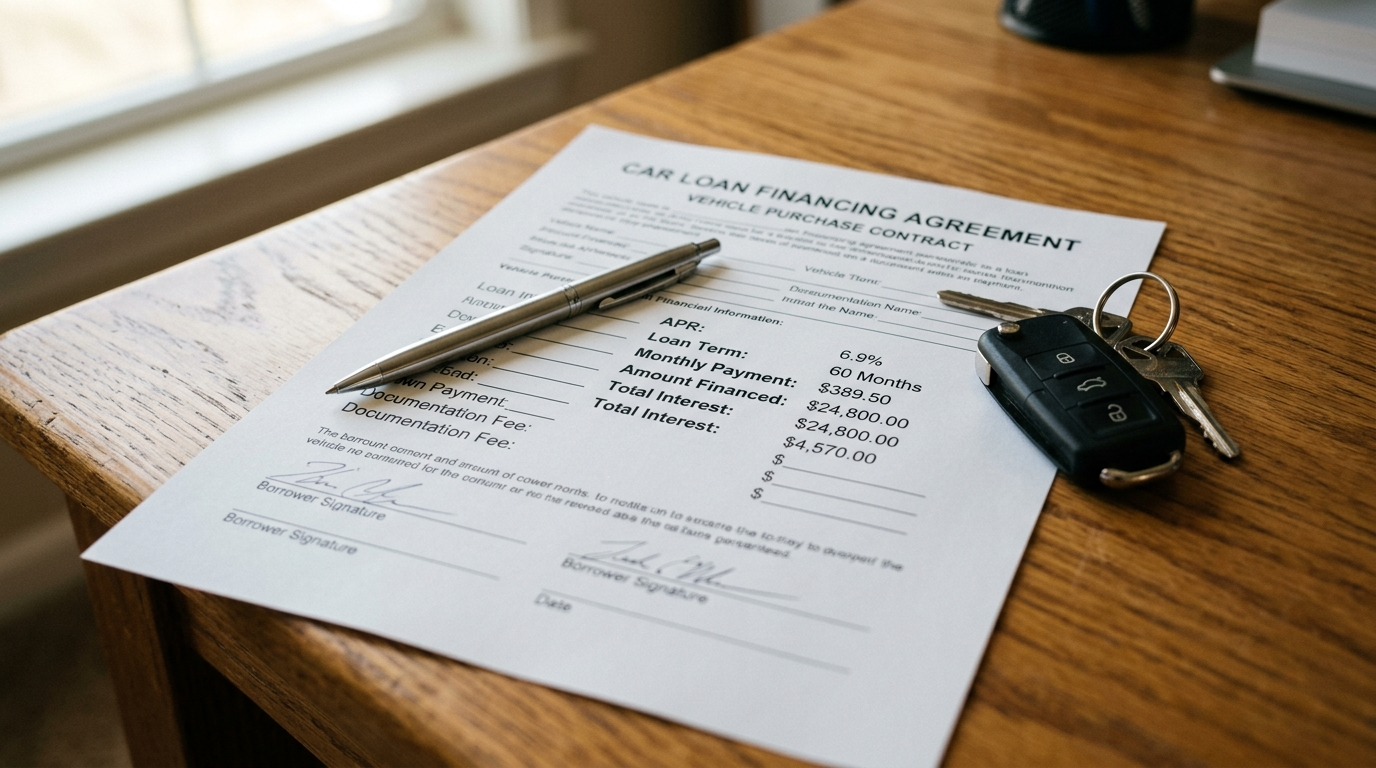
The monthly payment is the most dangerous number in a car dealership, because it's the only one most buyers look at, and it's engineered to look small. "Can you do $545 a month?" sounds like a question about affordability. It's actually a trick of framing, because a lower monthly payment almost always means a higher total cost. The number that matters is what the car actually costs you over the entire loan, and you can calculate it in about five minutes. Here's how to find the true cost of a car loan before you sign anything.
Dealers are masters of the monthly payment because it hides the two things that determine real cost: the interest rate and the length of the loan. Stretch the term, drop the payment, and the total you hand over quietly balloons. Once you learn to look past the monthly figure, the whole negotiation changes in your favor.
The Monthly Payment Is a Magic Trick
Focusing on the monthly payment is like judging a meal by the size of each bite instead of the bill. A dealer can hit almost any monthly target you name simply by extending the loan, and they'll happily do it, because a longer loan means more interest for the lender and a sale that "fits your budget" for you.
A lower monthly payment is not a discount; it's usually the opposite. The same car at the same price can cost you thousands more depending only on the term you accept. The monthly number tells you whether you can make this month's payment. It tells you nothing about whether you're getting a good deal, and those are completely different questions.
How to Calculate the True Total Cost
The real cost calculation is simple arithmetic. Multiply your monthly payment by the number of payments to get the total amount paid, then subtract the original loan amount to find the total interest. That interest figure is the true price of borrowing, and it's the number the monthly payment hides.
Take a $32,000 loan at 7% APR. Over 48 months, the payment is about $766, so you pay roughly $36,782 in total, including about $4,782 in interest. The payment feels manageable, but you should be looking at that $4,782, the actual cost of the financing. Run your own loan through the auto loan calculator to see your total cost, not just the monthly figure the dealer leads with.
Why a Longer Term Costs You More
Here's where the magic trick is exposed. Watch what happens to that same $32,000 loan at 7% as the term stretches to lower the monthly payment.
| Term | Monthly payment | Total interest |
|---|---|---|
| 48 months | ~$766 | ~$4,782 |
| 60 months | ~$634 | ~$6,016 |
| 72 months | ~$545 | ~$7,233 |
Going from 48 to 72 months drops the payment by about $221, which feels great in the showroom. But it adds roughly $2,451 to the total interest, and it keeps you in debt for two extra years on a depreciating asset. That "affordable" payment is one of the most expensive choices on the lot.
APR vs Interest Rate: The Fees Hiding in Financing
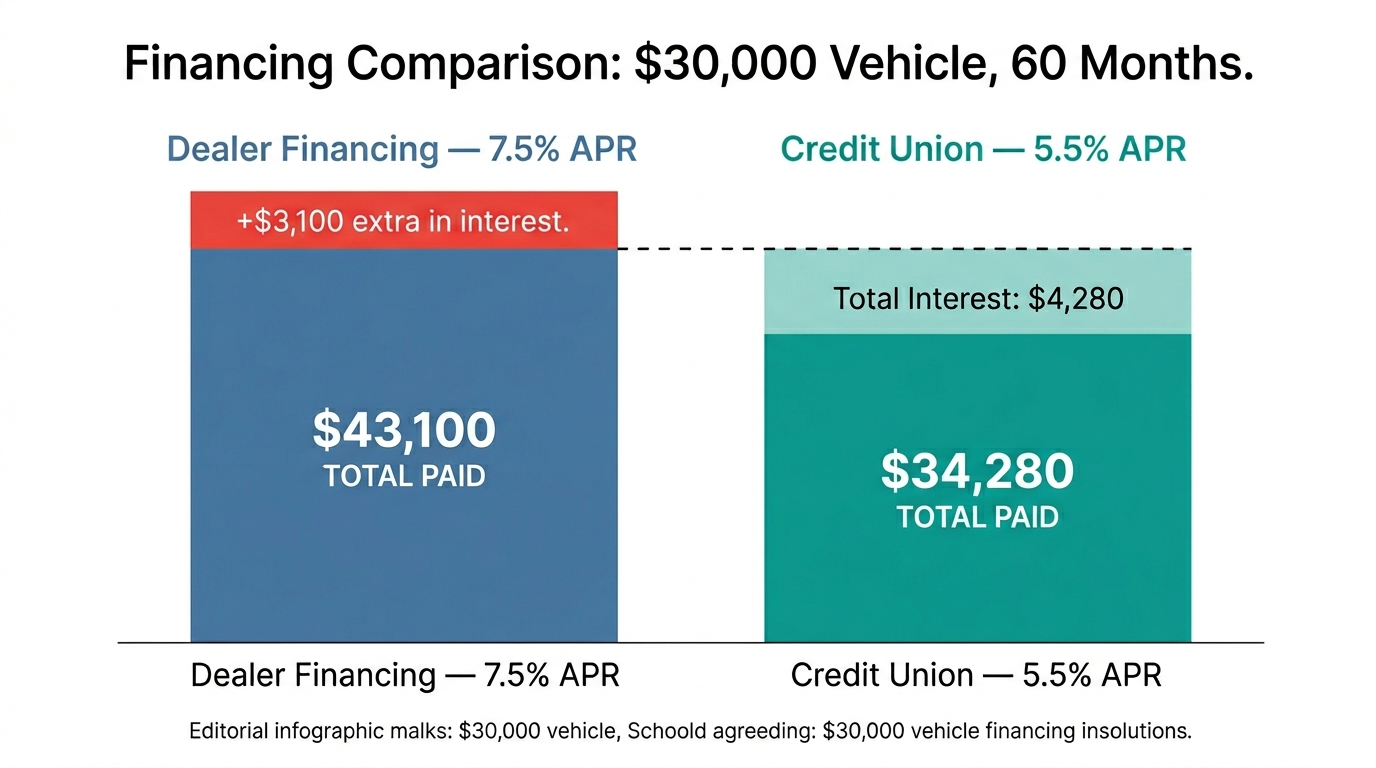
There are two rates on a car loan, and confusing them costs money. The interest rate is the base cost of borrowing. The APR, or annual percentage rate, includes the interest rate plus fees and certain charges, expressed as a yearly figure. The APR is always equal to or higher than the stated interest rate, and it's the honest number for comparing loans.
Always compare offers using APR, never the interest rate alone, because a loan with a low rate and high fees can cost more than one with a slightly higher rate and no fees. The APR calculator lets you compare financing options on equal footing, and the amortization calculator shows exactly how much of each payment goes to interest versus principal over time.
What Dealers Count On You Not Knowing
The financing office is where dealers often make more profit than on the car itself, and a few tactics rely on buyers focusing only on the monthly payment. Knowing them flips the power back to you.
- Payment-focused negotiation: when they ask "what payment works for you," they can hit it by stretching the term and burying a worse deal. Negotiate the total price and the APR, not the payment.
- Rate markup: dealers can add a margin to the rate your credit actually qualifies for. Getting pre-approved elsewhere exposes this instantly.
- Add-ons in the payment: extended warranties, paint protection, and gap insurance get folded in so a $40 monthly bump hides a $2,000 product.
The single best defense is to walk in pre-approved by your own bank or credit union. Then you have a real APR to beat, the dealer has to compete for your financing, and you can judge every offer against a number you already trust.
How to Pay Less Interest on Any Car Loan
Once you can see the true cost, lowering it is straightforward. A handful of moves cut the total interest on any car loan, often by thousands, and most of them are within your control before you ever walk into a dealership.
- Choose the shortest term you can comfortably afford. As the table showed, this is the single biggest lever on total interest. Aim for 48 months or less when you can.
- Put more money down. A larger down payment shrinks the amount you finance, which reduces both the payment and the total interest, and protects you from owing more than the car is worth.
- Improve your credit before applying. The rate you qualify for is driven by your credit score. Even a small score improvement can drop your APR by a point or more, worth thousands over the loan.
- Skip the add-ons financed into the loan. Extended warranties and extras folded into the balance accrue interest for the whole term. If you want them, pay separately or decline.
Stacked together, these can turn a punishing loan into a reasonable one on the exact same car. The buyer who puts more down, takes a shorter term, and walks in with a strong pre-approved rate can pay less than half the interest of the buyer who accepts the dealer's long-term, low-payment offer. Same vehicle, thousands of dollars apart, decided entirely by how the financing was structured.
Run It Before You Sign
The whole game changes when you evaluate a car loan by total cost instead of monthly payment. Calculate the total interest, compare offers by APR, choose the shortest term you can comfortably afford, and never let the conversation collapse to "what can you pay a month."
This is a perfect question for the built-in AI assistant on the calculator pages. Tell it something like "I'm looking at a $32,000 loan, the dealer offered 72 months at 7%, what's it really costing me and what term should I take," and it lays out the total cost and the tradeoff instead of leaving you to do it under fluorescent showroom lights. The payment is what they want you to see. The total cost is what you should decide on, and now you can.

A car is one of the largest purchases most people make, and the financing decision can cost or save several thousand dollars on the identical vehicle. Spend the five minutes to run the real numbers. The dealer spent years learning how to frame the payment; you only need a few minutes to see past it.
Frequently Asked Questions
How do you calculate the total cost of a car loan?
Multiply your monthly payment by the number of payments (loan term in months) to get the total amount paid. Subtract the original loan principal from that total to find the total interest paid. For a $28,000 loan at 7% APR over 60 months, the total cost is $33,240 with $5,240 in interest.
What is a good APR for a car loan in 2024?
For borrowers with excellent credit (720+), rates between 4% and 6% are competitive for new cars. For used cars, expect 1 to 2 percentage points higher. Rates above 10% indicate either lower credit score or unfavorable dealer financing terms worth shopping around on.
Is a longer car loan term better?
No. Longer loan terms reduce your monthly payment but significantly increase total interest paid. A $32,000 loan at 7% over 48 months costs $5,128 in interest. The same loan over 72 months costs $7,847. You pay $2,719 more for a lower monthly payment.
What is the difference between the APR and the interest rate on a car loan?
The interest rate is the base borrowing cost. The APR (Annual Percentage Rate) includes the interest rate plus fees and other charges, expressed as a yearly rate. APR is always equal to or higher than the stated interest rate. Always compare loans using APR, not interest rate alone.
Can I negotiate my car loan interest rate?
Yes. Get pre-approved by your bank or credit union before visiting the dealership. Dealers can often beat or match outside financing, but only when you come in with a competing rate. Without pre-approval, you have no leverage to negotiate the financing terms.