
How to Pay Off $20,000 in Credit Card Debt: A Step by Step Payoff Plan
Carrying $20,000 in credit card debt is not a life sentence. This step by step guide shows you exactly how to organize your debts, choose a payoff method, set your monthly target, and reach zero faster than you think.

Paying off $20,000 in credit card debt feels impossible right up until you turn it into a schedule. The reason it feels hopeless is that the credit card company designed it to. The minimum payment is engineered to keep you paying for decades while the balance barely moves. The moment you stop reacting to minimums and start running the numbers yourself, $20,000 in credit card debt stops being a life sentence and becomes a project with a finish line. This is the step-by-step plan to get there, with the real math at every stage.
There's no trick here, no secret loophole, and no product to buy. What works is a sequence: see the true cost of doing nothing, list what you owe, pick a payoff method, free up a monthly attack number, cut the interest rate where you can, and protect yourself so the debt never comes back. Work the steps in order and the result takes care of itself.
The Real Cost of Paying the Minimum
The single most expensive habit in personal finance is paying only the minimum on a credit card. Minimums are usually set around 2% of the balance, which on a 22% APR card barely clears the interest. You are running on a treadmill, paying real money every month while the balance refuses to fall.
Here's what the same $20,000 balance at roughly 22% APR looks like at different monthly payments. The numbers are calculated from the standard amortization formula, so you can reproduce them yourself.
| Monthly payment | Time to payoff | Total interest paid |
|---|---|---|
| Minimum only (~$400, falling) | 30+ years | $25,000+ |
| $500 | ~73 months | ~$16,400 |
| $700 | ~41 months | ~$8,600 |
| $1,000 | ~25 months | ~$5,100 |
Read that table twice. Moving from $500 to $1,000 a month cuts your interest from roughly $16,400 to roughly $5,100, a swing of more than $11,000. The size of your monthly payment matters more than almost anything else you'll do. Everything that follows is about pushing that payment as high as you can, as quickly as you can. Model your own balance and rate on the credit card payoff calculator before you commit to a number.
It helps to understand why the minimum is set so low. The lender's most profitable customer is not the one who defaults; it's the one who pays faithfully, on time, forever, never quite clearing the balance. A 2% minimum is calibrated to feel manageable while keeping you in revolving debt for decades. That isn't a conspiracy theory, it's the published business model of the card industry. Seeing the minimum for what it is, a tool designed to maximize the interest you pay, is the mental shift that makes the rest of this plan click. You're not being a difficult customer by paying far more than the minimum. You're simply refusing to volunteer for the most expensive option on the menu.
Step 1: Lay Every Debt on the Table
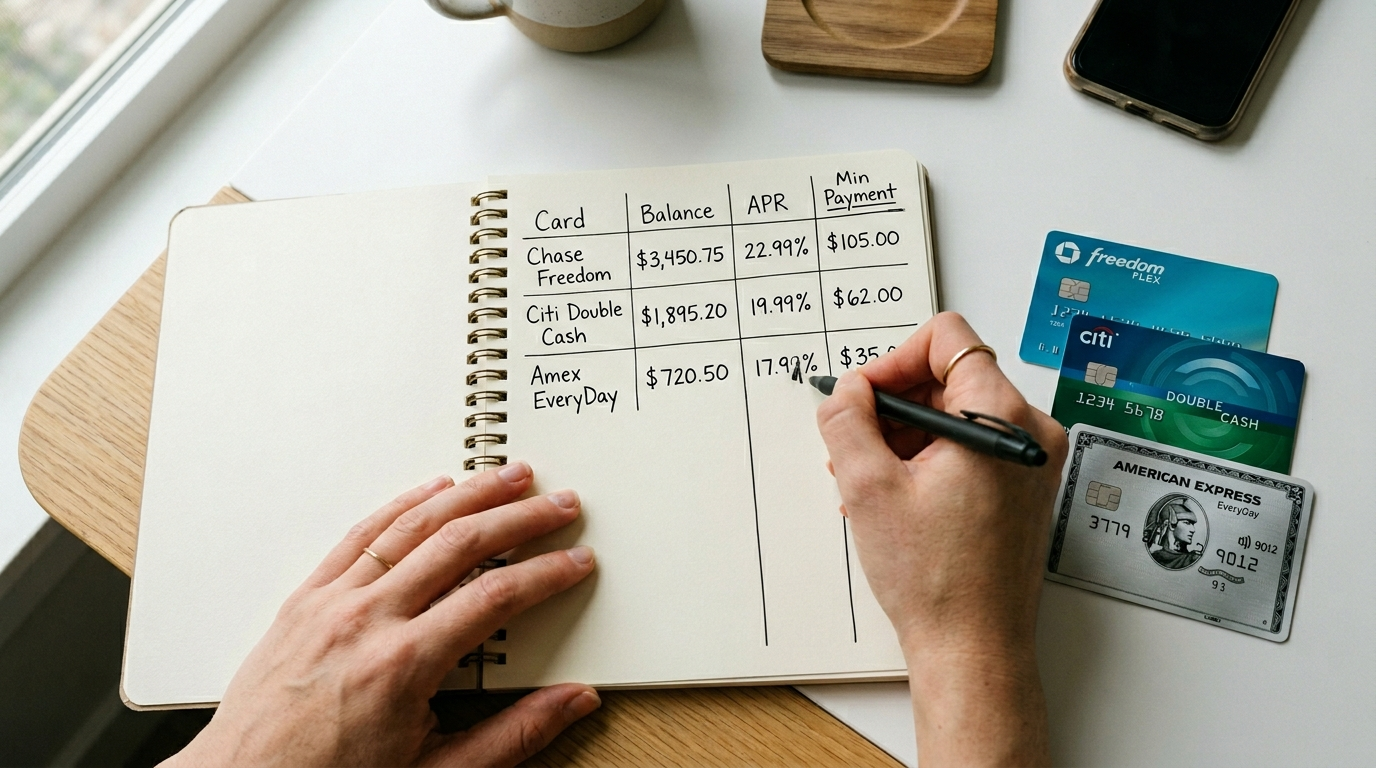
You cannot beat a debt you haven't fully looked at. Most people in debt carry a vague, anxious estimate in their head that is usually lower than reality. The first move is to replace the anxiety with a list.
Write down every card and loan in one place. For each one, record four things: the current balance, the APR, the minimum payment, and the statement due date. That's it. Seeing all of it on a single page does two things at once: it kills the dread of the unknown, and it shows you exactly where the highest interest is doing the most damage.
Take a realistic example of $20,000 spread across three cards. One card holds $4,000 at 26.99%, another $9,000 at 22.99%, and a third $7,000 at 18.99%, with minimums totaling around $400. Until you write this out, the $4,000 card looks like the small one. Once you see the APR, you realize it's the most dangerous balance you own, because it grows fastest.
If you're not certain you've captured everything, pull your free credit report from all three bureaus. It lists every open account in your name, including forgotten store cards and old balances you may have stopped thinking about. People are routinely surprised to find a dormant card still charging interest, or a balance they assumed was closed. You cannot build an accurate plan around a number that's missing pieces, so this five-minute check is worth doing before you go further. Write the complete picture down once, and you never have to carry it in your head again.
Step 2: Choose Your Method, Avalanche or Snowball
Once your debts are listed, you need an order of attack. You'll pay the minimum on everything, then throw every spare dollar at one target card until it's gone, then roll that money to the next. The only question is which card goes first, and there are two proven answers.
The avalanche method targets the highest APR first. The snowball method targets the smallest balance first. Both work. They simply optimize for different things: avalanche for money, snowball for motivation.
| Factor | Avalanche | Snowball |
|---|---|---|
| Pay first | Highest APR card | Smallest balance card |
| Best for | Paying the least total interest | Staying motivated with quick wins |
| First card cleared | Slower | Faster, often within months |
| Total cost | Lowest | Slightly higher |
On the $20,000 example, avalanche attacks the $4,000 card at 26.99% first and saves the most interest overall. Snowball also attacks the $4,000 card first here, because it happens to be the smallest too, which is the ideal case where both methods agree. When they disagree, choose avalanche if you trust yourself to stay the course, and snowball if you know you need an early victory to keep going. The math difference between them is usually a few hundred dollars; the difference in whether you finish at all can be everything.
Picture how it plays out on the example. With $700 a month flowing in, the $4,000 card at 26.99% absorbs its minimums plus all the extra and disappears in roughly six months. The moment it's gone, its old minimum doesn't return to your pocket. It rolls onto the next card, so your attack power grows with each cleared balance even though your budget never changes. That snowballing of freed-up minimums is why the final card falls far faster than the first, and why the last stretch of a payoff feels like sprinting downhill. The hardest month is month one; every month after that, the math tilts a little more in your favor.
Step 3: Find Your Monthly Attack Number
Your attack number is the total you send to debt each month: every minimum plus every extra dollar you can find. Raising it is the highest-leverage move available to you, so this step is worth real effort rather than a shrug.
Find the extra money in two directions. Cut spending on the expense side, and raise cash on the income side. On spending, a temporary freeze on dining out, subscriptions, and impulse buys can free $200 to $500 a month for most households without permanent sacrifice. On income, a few months of overtime, freelance work, or selling unused items can add a few hundred more. Every dollar you add lands directly on the table above and pulls your payoff date closer.
If $300 a month sounds out of reach, break it into pieces rather than one big number. A typical household can usually assemble it from several small sources at once:
- Pause two or three subscriptions you rarely use: often $40 to $60 a month recovered instantly.
- Cook five extra dinners at home instead of ordering in: commonly $150 to $250 a month for a small household.
- Cancel one "convenience" habit such as daily coffee out: roughly $80 to $120 a month.
- Sell unused items in the first month for a one-time boost that clears a chunk of the smallest balance immediately.
None of these are permanent sacrifices. They're a temporary redirection of money you're already spending, switched on only until the debt is gone and switched back off once you're free. Framing it as temporary, not as deprivation forever, is what makes people actually stick with it.
A simple budgeting frame helps here. Map your take-home pay across needs, wants, and debt, and squeeze the wants category hard while the debt exists. Check that your overall obligations are sustainable using the debt-to-income ratio calculator; if your ratio is high, lenders see you as stretched, which is another reason to clear the balances fast.
Step 4: Cut the Interest Rate While You Pay
While you attack the balance, attack the rate. Lowering the APR means more of each payment hits the principal instead of the lender's pocket. There are three realistic levers.
- Balance transfer card: a 0% introductory APR for 12 to 21 months can pause interest entirely. Watch the transfer fee, usually 3 to 5%, and have a plan to clear the balance before the promo ends.
- Debt consolidation loan: a fixed-rate personal loan at 9 to 14% replaces card APRs in the low-to-mid twenties. It also converts revolving debt into a structured payoff with a guaranteed end date.
- A direct call to your issuer: the most underused option. Long-standing customers can often get a rate reduction just by asking, especially with a record of on-time payments.
Run the comparison before you move money. Use the APR calculator to confirm that a transfer fee or loan origination cost is actually smaller than the interest you'd save. A 3% transfer fee on $20,000 is $600; if it saves you several thousand in interest, it's an easy yes, but only the numbers can tell you.
Step 5: Build the Wall That Keeps Debt Out
Plenty of people pay off their cards and land right back in debt within a year. The payoff plan only sticks if you build something to stop the cycle, and that something is a small emergency fund.
Most credit card debt starts with an unplanned expense: a car repair, a medical bill, a job gap. Without cash set aside, the card becomes the emergency fund, and the balance climbs again. Park even $1,000 to $2,000 in a separate savings account before you finish the payoff, so the next surprise hits your savings instead of your card. Size your target with the emergency fund calculator, then build toward a full three to six months once the cards are clear.
Keep the paid-off cards open. Closing them shrinks your available credit and raises your utilization ratio, which can drop your score right after you've done the hard work. Use one card for a small recurring charge you pay in full each month, and leave the rest alone.
The deeper work in this step is breaking the pattern that created the debt in the first place. For most people that means removing stored card numbers from shopping apps and browsers, unsubscribing from retailer marketing emails, and waiting 24 hours before any non-essential purchase over a set amount. The debt was built one easy swipe at a time, and it stays gone the same way: by making the easy swipe slightly harder. A payoff plan is the sprint. These small friction habits are what keep you from ever running this race again.
Common Mistakes That Stall a Payoff Plan
Most payoff plans don't fail because the math was wrong. They fail because of a handful of predictable mistakes that quietly drain progress. Knowing them in advance is half the battle.
The first and most common is adding new debt while paying off the old. If you're putting $700 a month toward the cards but charging $300 of new spending back onto them, your real progress is only $400. The balance feels stuck because it is. Paying down a card you're still actively using is like bailing a boat without finding the leak. For the duration of the plan, treat the cards as frozen and run daily spending from cash or debit.
The second is spreading extra money evenly across every card. It feels fair, but it's mathematically the slowest route. Splitting $300 of extra across three cards clears none of them quickly, so you never get the momentum of a finished balance or the freed-up minimum that comes with it. Concentrate everything on one target card while paying minimums on the rest.
The third is draining every last dollar of savings into the debt. It feels aggressive and virtuous, right up until the car breaks down and the only available money is the card you just paid off. Keep a small cash buffer in place so a normal emergency doesn't reload the very balance you're killing. The fourth is chasing rewards points while carrying a balance: no cashback rate comes close to a 22% interest charge, so the points are an illusion until the debt is gone. The fifth is quitting after the first card is cleared and letting the freed-up payment leak back into lifestyle spending instead of rolling it to the next card.
What to Do If You Can't Make the Minimum Payments
Sometimes the problem isn't optimization, it's survival: the minimums alone are more than the budget can cover. If that's where you are, the worst possible move is to go silent and start missing payments. There are real options, and they work far better when you reach for them early.
Call the issuer first. Most major card companies run hardship programs that can temporarily lower your interest rate, reduce or pause minimum payments, or waive fees for a set period. These programs exist because a creditor would rather collect less than watch the account default entirely. They are rarely advertised, so you usually have to ask directly and explain your situation.
If the problem is bigger than one card, a nonprofit credit counseling agency can help. Reputable agencies, including those affiliated with the National Foundation for Credit Counseling, offer free reviews and can set up a debt management plan that consolidates your payments and negotiates lower rates with your creditors. Be cautious with for-profit "debt settlement" firms that promise to slash your balances. Settlement can severely damage your credit, the forgiven amount may be taxed as income, and the field is full of high-fee operators. Use the debt-to-income ratio calculator to see how stretched you actually are, and treat bankruptcy as a genuine last resort to discuss with a qualified advisor rather than a first move.
Your Realistic Payoff Timeline
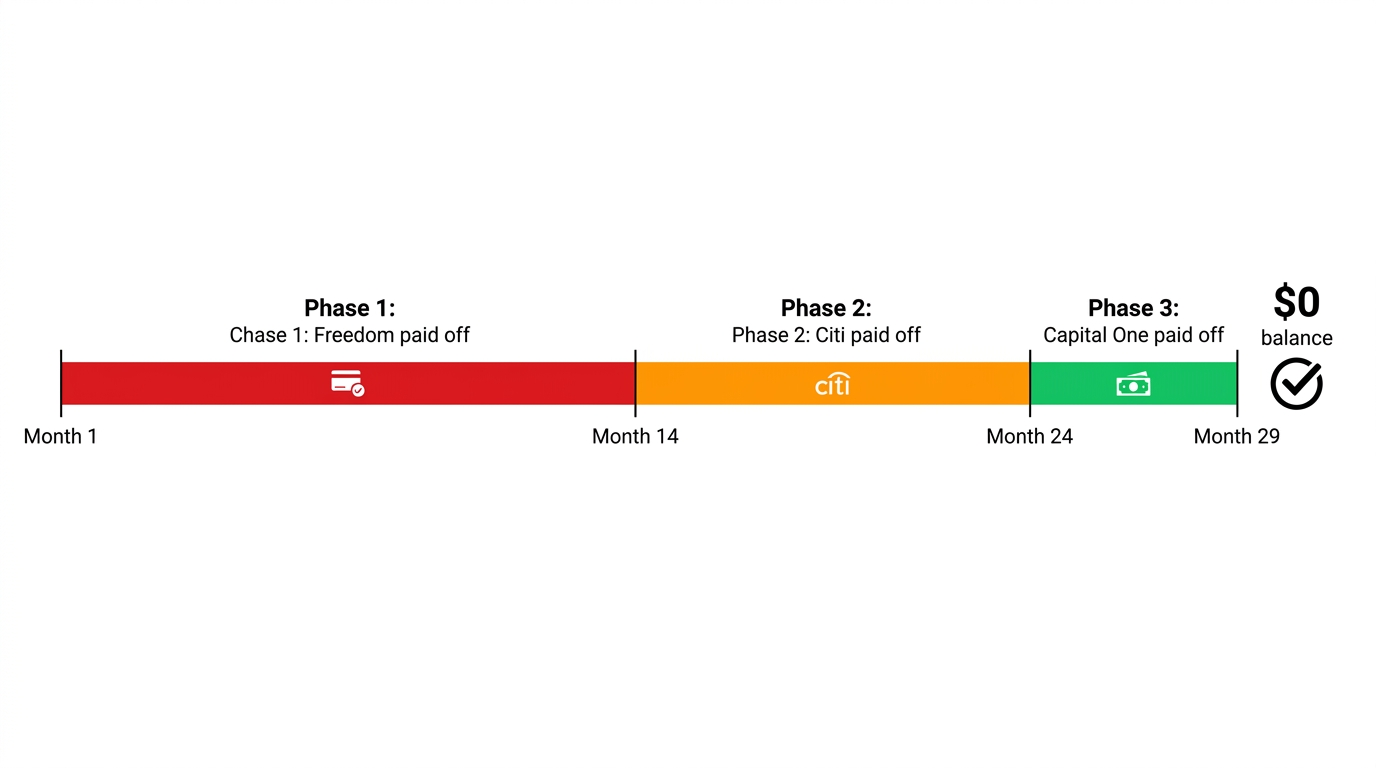
Put it together and the abstract becomes a calendar. On the $20,000 example at a $700 monthly attack, avalanche clears the 26.99% card in roughly six months, the 22.99% card around the two-year mark, and the final card near month 41. Total interest lands close to $8,600 instead of the $25,000-plus a minimum-only path would cost.
This is where the built-in AI assistant on the calculator pages earns its keep. After you enter your balances and rates, you can ask it something specific like "I have $20,000 across three cards and can pay $700 a month, which order saves me the most and when am I debt-free," and it will lay out the sequence and the date instead of leaving you with a raw figure. A plan you can see is a plan you can finish. The debt that looked like a wall is just a number with a deadline attached, and the deadline is closer than it feels today.
One last piece of advice: track your progress somewhere you'll see it. A simple chart on the fridge showing the balance dropping, or a number you update every payday, turns an abstract plan into visible momentum. Debt payoff is as much a psychological project as a financial one, and watching the line fall is what carries you through the slow middle months. Celebrate each cleared card. You earned it, and the next one falls faster.
Frequently Asked Questions
What is the fastest way to pay off credit card debt?
The avalanche method is mathematically fastest: pay the minimum on all cards and direct every extra dollar toward the card with the highest interest rate. This minimizes the total interest you pay over the life of your debt.
How long does it take to pay off $20,000 in credit card debt?
Paying only the minimum at 20% APR would take over 20 years. Paying $600–$800 per month extra reduces this to approximately 3–4 years, depending on your interest rate.
What is the difference between the avalanche and snowball debt payoff methods?
The avalanche method targets the highest interest rate first and saves the most money. The snowball method targets the smallest balance first for quick wins that build momentum. Both work — the best one is the one you will stick to consistently.
Does paying off credit card debt improve your credit score?
Yes. Reducing your credit card balances lowers your credit utilization ratio, one of the biggest factors in your credit score. Getting utilization below 30% typically produces a significant score improvement within 1–2 billing cycles.
Should I use savings to pay off credit card debt?
Generally yes — if your credit card APR (often 18–24%) is higher than your savings account yield (typically 4–5%), paying down the debt first produces a guaranteed return equal to the interest rate you eliminate.