
Weighted GPA vs Unweighted GPA: What Colleges Actually Look At
Most selective colleges recalculate your GPA using their own formula and ignore the number on your transcript entirely. Here's what actually drives admissions decisions, how both GPA types are calculated, and what you should focus on.
Two students both report a 4.0 GPA. One earned straight A's in regular classes; the other earned a mix of A's and B's across a schedule packed with AP and honors courses. On a weighted scale, the second student might show a 4.5, while on an unweighted scale they'd both sit at 4.0. So which number is "real," and which one do colleges actually use? The answer surprises most students and parents: selective colleges often ignore both numbers on your transcript and calculate their own. Here's how weighted and unweighted GPA really work, and what admissions offices are actually looking at.
The confusion is understandable, because the two scales measure different things and schools apply them inconsistently. Understanding the distinction matters, not because one number is magic, but because it changes what you should focus on in high school. Let's break down both.
The Two Scales, Side by Side
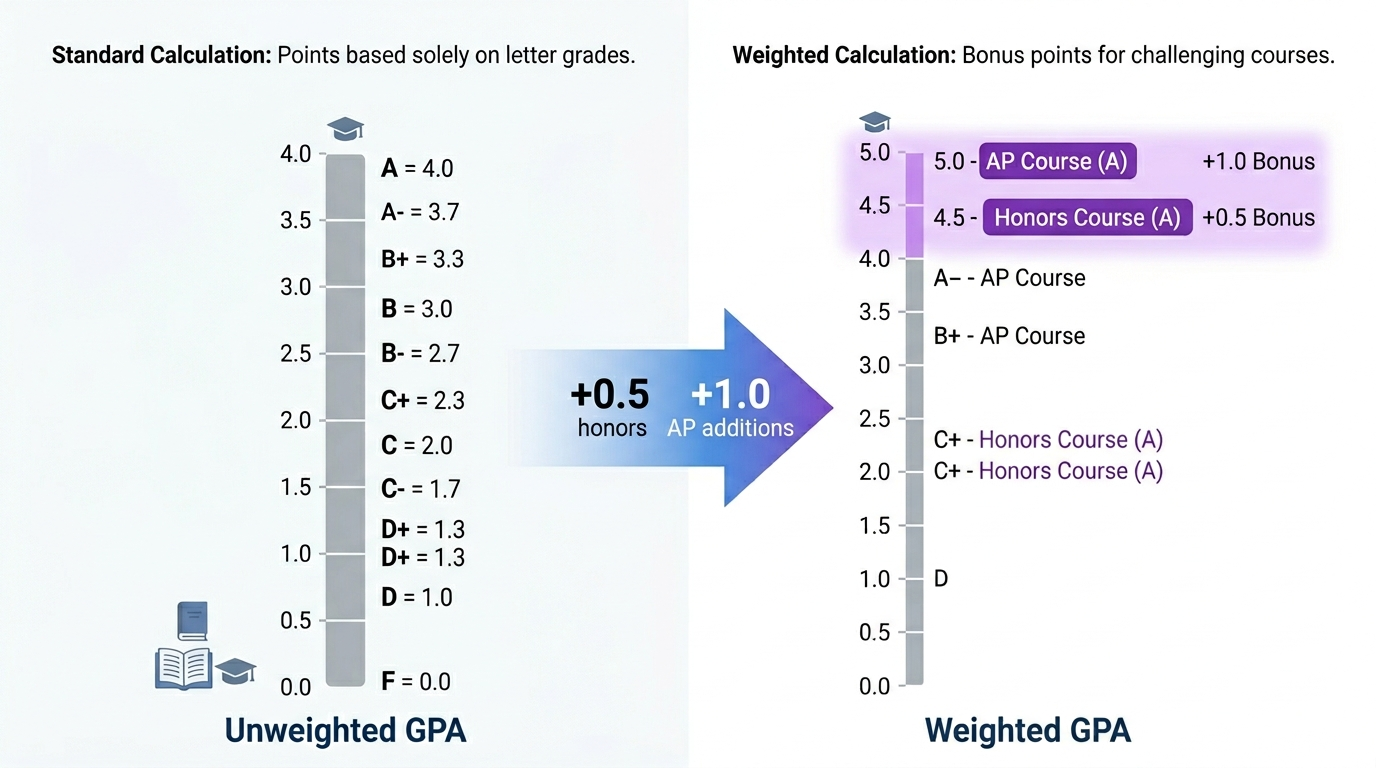
An unweighted GPA uses the classic 0 to 4.0 scale, where an A is always 4.0 no matter how hard the class was. It measures performance, plain and simple, treating an A in gym and an A in AP Calculus identically. It's clean and comparable, but it's blind to difficulty.
A weighted GPA adds bonus points for harder courses, typically +0.5 for honors and +1.0 for AP or IB classes, pushing the maximum to 5.0. It rewards rigor: a student taking demanding courses can score above the 4.0 ceiling. The unweighted number shows how well you did; the weighted number tries to show how hard you challenged yourself. Both matter, and they answer different questions.
How Each Is Calculated
The calculation makes the difference concrete. Take a B+ in AP US History. On the unweighted scale, a B+ is 3.3, full stop. On a weighted scale that adds 1.0 for an AP course, that same B+ becomes 4.3, which is higher than an unweighted A in a regular class.
To find your weighted GPA, assign each course its grade points, add the weighting bonus for its level (+0.5 honors, +1.0 AP or IB), then average across all courses. An A in an AP class becomes 5.0; an A in a regular class stays 4.0. Run both versions of your own transcript with the GPA calculator to see how far apart your two numbers actually are. The gap between them is itself a signal of how much rigor you've taken on.
| Grade & course | Unweighted | Weighted |
|---|---|---|
| A in regular class | 4.0 | 4.0 |
| A in honors class | 4.0 | 4.5 |
| B+ in AP class | 3.3 | 4.3 |
| A in AP class | 4.0 | 5.0 |
Why Colleges Recalculate Both
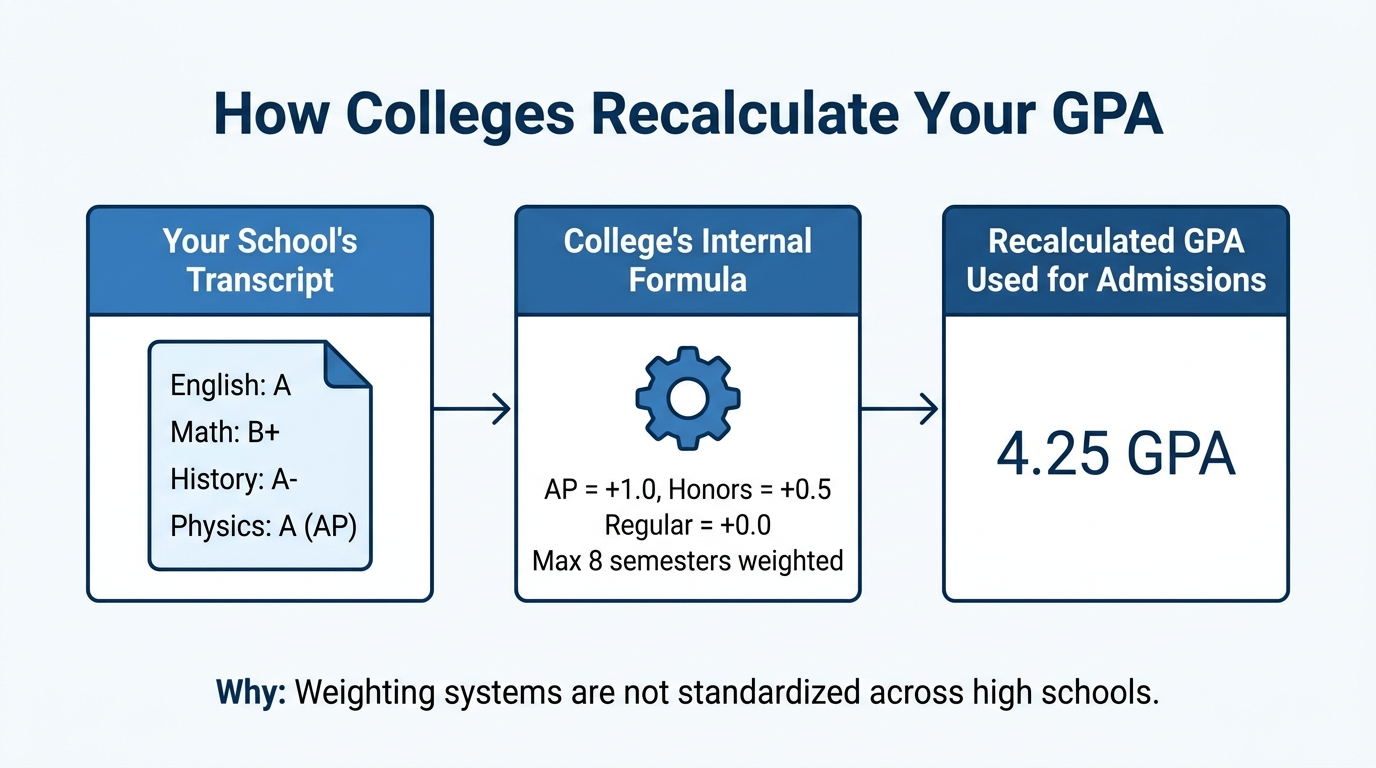
Here's the part that catches families off guard: most selective colleges don't trust either number on your transcript. They recalculate your GPA using their own internal formula, because weighting systems aren't standardized. One school adds 1.0 for AP; another adds 0.5. One weights every course; another only core academics. A 4.5 weighted GPA means something completely different from one high school to the next.
To compare applicants fairly, admissions offices strip out the local weighting and apply one consistent method to everyone, often recalculating an unweighted academic GPA from your raw grades and then reading your course rigor separately. This is why obsessing over your weighted number can mislead you. The college is going to rebuild it their way regardless. What they're really doing is looking at two things together: how well you performed, and how challenging a schedule you performed it in.
Does an AP Boost Actually Help?
Since colleges recalculate, does loading up on AP classes for the GPA bump actually pay off? Yes, but not in the way students often think. The value isn't the inflated weighted number; it's the demonstrated rigor. Admissions officers want to see that you challenged yourself with the hardest courses available to you and did well in them.
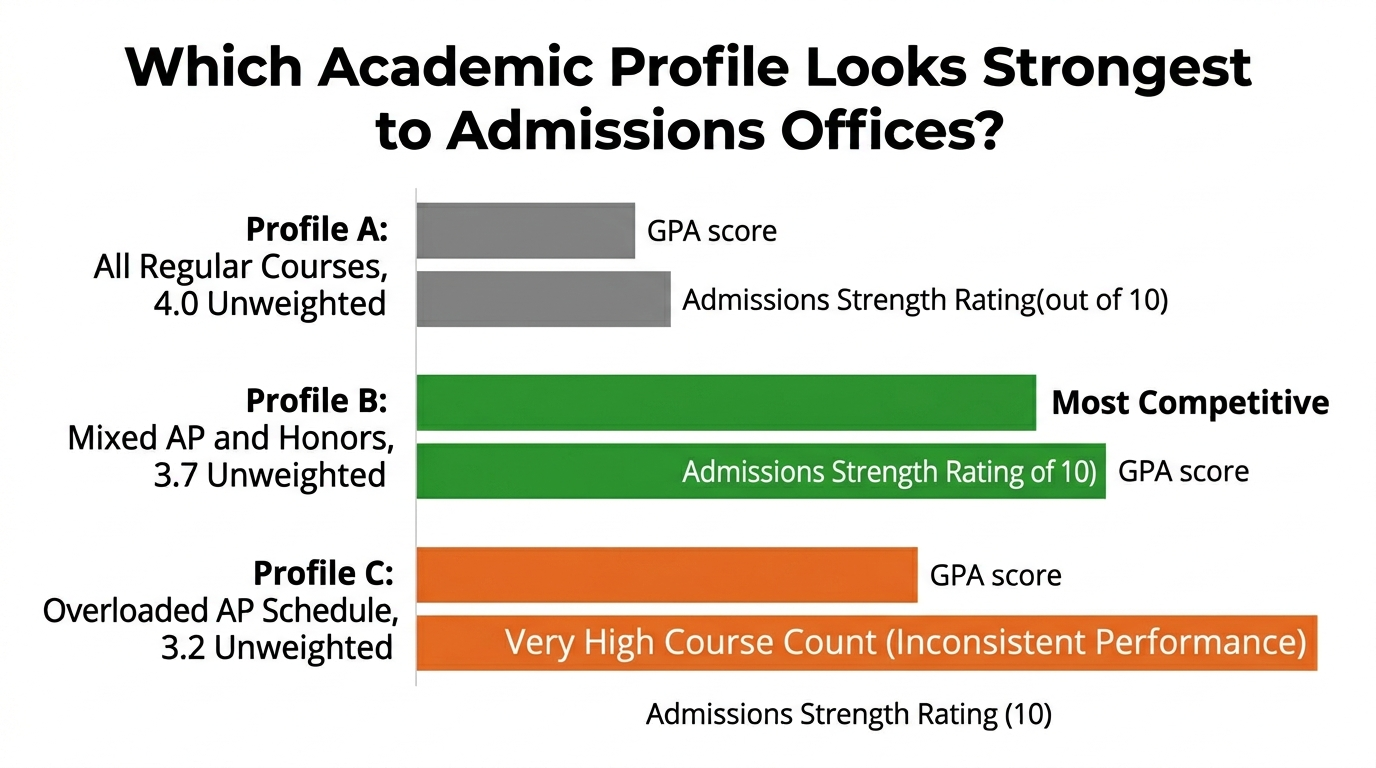
That distinction matters for strategy. Taking an AP class and earning a B genuinely strengthens your application by showing rigor, even though the unweighted hit looks scary. But taking every AP available and collecting C's does not, because performance within hard courses still counts. The sweet spot is a demanding schedule with strong grades, which signals both ambition and the ability to deliver on it. Course rigor with solid results beats both an easy 4.0 and an overreaching transcript full of low grades.
Can a High Weighted GPA Hide a Low Unweighted One?
Some students hope a gaudy weighted GPA will paper over weak underlying grades. At selective schools, it won't, because admissions officers look at both numbers side by side. A high weighted GPA paired with a low unweighted one tells a specific and not entirely flattering story: ambitious course selection, inconsistent execution.
That combination, lots of hard classes with mostly B's and C's, reads as a student who reached for rigor but struggled to deliver. It's generally viewed less favorably than a slightly less aggressive schedule with strong grades. The takeaway is that you can't out-weight poor performance. The two numbers travel together, and the unweighted one keeps the weighted one honest, which is exactly why colleges look at the pair rather than either alone.
How Weighting Varies From School to School
Part of why colleges distrust the weighted number is that no two high schools weight the same way, and the differences are larger than most families realize. The lack of a standard is the entire reason your weighted GPA is hard to compare to anyone else's.
Some schools add a full 1.0 for AP courses; others add 0.5. Some apply honors and AP bonuses to every class; others only to core academic subjects, excluding electives. A few use a 4.0 weighted scale that compresses the bonuses, while others run a true 5.0 or even higher. The result is that a 4.5 at one school might represent a heavier, more rigorous load than a 4.7 at another, which is precisely the kind of distortion admissions offices recalculate away.
The practical consequence for you is to never assume your weighted GPA means the same thing to a college that it means in your hallway. Class rank, where schools still report it, is similarly affected by the local weighting system. When you compare yourself to students at other schools, the unweighted number is the more honest common ground, because it's the one figure that means the same thing everywhere: how well you actually performed.
Calculate Both and Focus on What Matters
The practical move is to know both your numbers and stop over-weighting the weighted one. Calculate your unweighted GPA, since that's closest to what colleges will rebuild, and track your weighted GPA mainly as a measure of how much rigor you've taken on. Then put your energy where it counts: strong grades in genuinely challenging courses.
This is a good question for the built-in AI assistant on the calculator pages. Tell it something like "I have a 3.8 unweighted and a 4.4 weighted with five APs, how will colleges read this," and it explains what your numbers signal together instead of leaving you to decode admissions logic alone. Run both figures with the grade calculator as you plan each semester, and check how your testing supports your profile with the SAT score calculator. Weighted or unweighted, the real goal is the same: do well in hard classes, and let both numbers reflect it.
Frequently Asked Questions
What is the difference between weighted and unweighted GPA?
An unweighted GPA uses a standard 0 to 4.0 scale where an A is always 4.0 regardless of course difficulty. A weighted GPA adds bonus points for harder courses: typically +0.5 for honors classes and +1.0 for AP or IB courses, raising the maximum possible GPA to 5.0. A student with a 3.7 unweighted GPA built on AP and honors courses may have a 4.3 weighted GPA, reflecting the added difficulty of their coursework.
Do colleges prefer weighted or unweighted GPA?
Most selective colleges recalculate your GPA using their own internal formula rather than using either version reported on your transcript. Weighting systems are not standardized across high schools, so a 4.5 weighted GPA at one school may represent a completely different level of rigor than a 4.5 at another. Admissions offices read your raw transcript and apply their own consistent formula to make fair comparisons across all applicants.
What GPA do you need to get into a selective university?
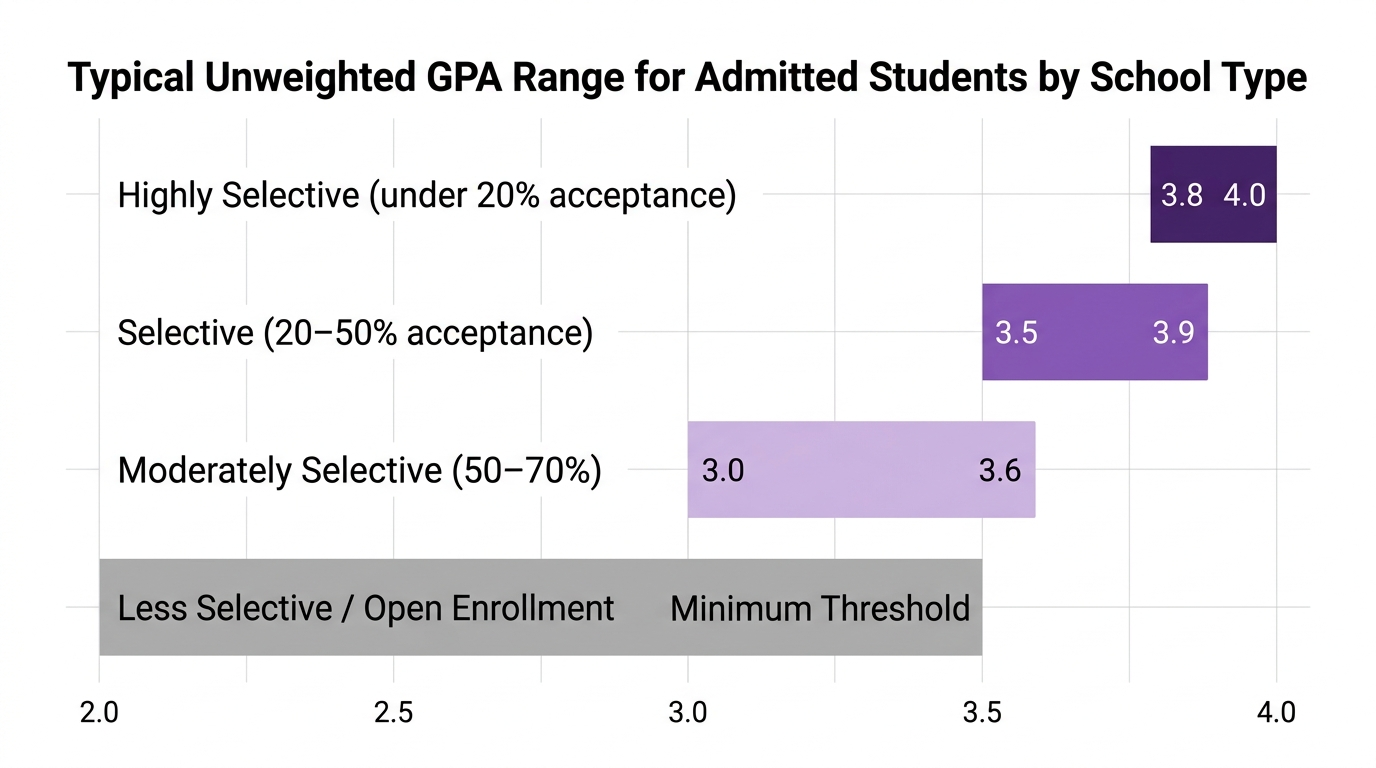
Highly selective universities with acceptance rates below 20% typically admit students with unweighted GPAs of 3.8 to 4.0. Selective schools with acceptance rates of 20 to 50% generally admit students with unweighted GPAs of 3.5 to 3.9. More important than the specific number is the pattern of course rigor: a 3.7 unweighted built on maximum AP and honors coursework is more competitive than a 4.0 built entirely on regular-level classes.
How much does an AP class boost your weighted GPA?
Most weighting systems add 1.0 grade point for AP and IB courses. This means a B in an AP class (3.0 unweighted) becomes 4.0 weighted, equal to an A in a regular course. An A in an AP class becomes 5.0 weighted, above the standard 4.0 ceiling. Honors courses typically receive a +0.5 boost. The exact bonus varies by school and district, which is why colleges recalculate using their own system.
Can a high weighted GPA make up for a low unweighted GPA?
Not typically at selective schools. Admissions officers look at both numbers together. A high weighted GPA paired with a low unweighted GPA signals ambitious course selection but inconsistent execution. Strong course rigor with solid performance, such as mostly B's and A's in AP and honors classes, reads better than a transcript of C's in every available AP course. Quality of performance within challenging courses matters more than the quantity of hard courses taken.
How do I calculate my weighted GPA?
Assign grade points to each course based on your letter grade using the standard scale (A = 4.0, B = 3.0, etc.), then add the weighting bonus for course level (+0.5 for honors, +1.0 for AP or IB). Average all the resulting weighted grade point values across every course. For example, a B+ in AP History earns 3.3 + 1.0 = 4.3 weighted points. Divide the total weighted points by your number of courses to get your weighted GPA.